Salt Dough Baby Print Ornaments

Find Northbird on social media:

This post contains affiliate links. As an Amazon associate, I earn from qualifying purchases. This means that I make a small commission at no extra cost to you. You can read my full disclosure HERE.

Jump to Printable Directions

Jump to Video

Return to “Homeschooling Activities & Resources”

Return to “Christmas Activities and Crafts”
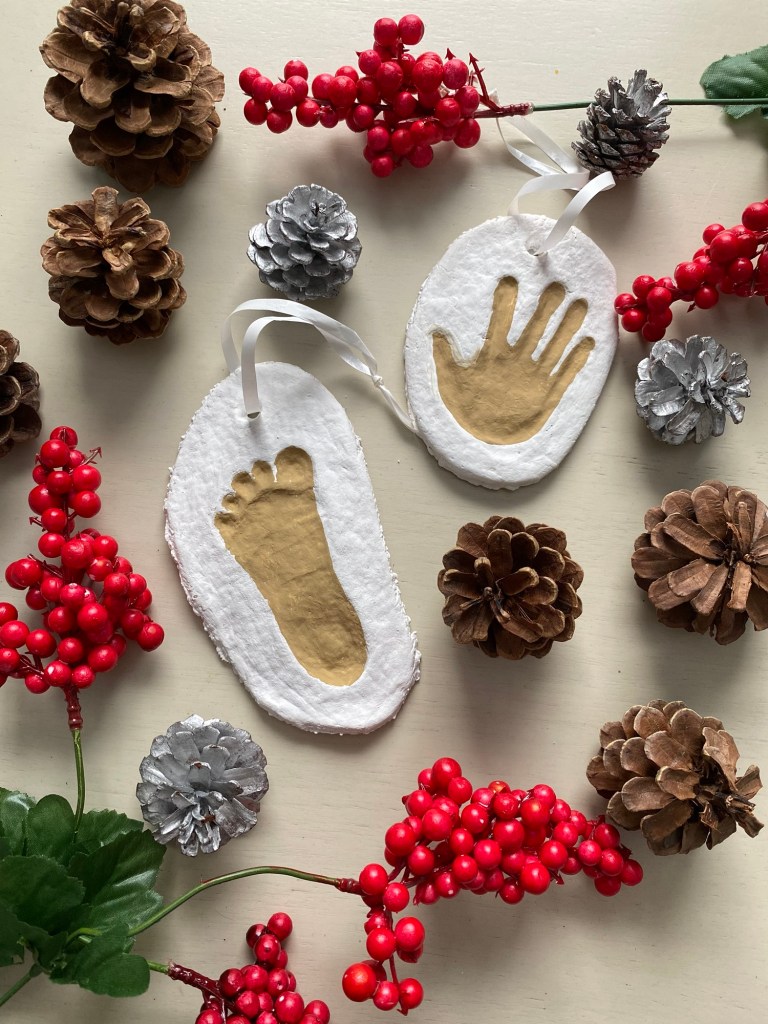
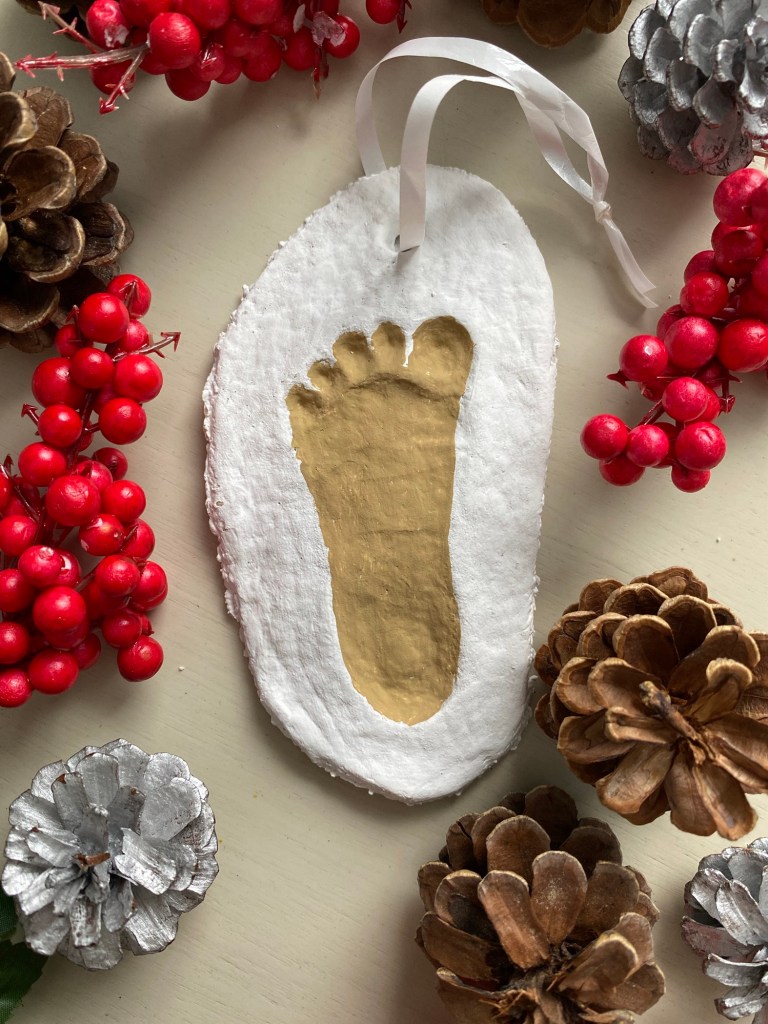
With each baby that we’ve had, we have this lovely tradition to make a salt dough imprint of their tiny feet or hands every Christmas and turn it into a special ornament for our Christmas garland.

I love having this precious memento to remind myself of our little girls when they were this tiny!
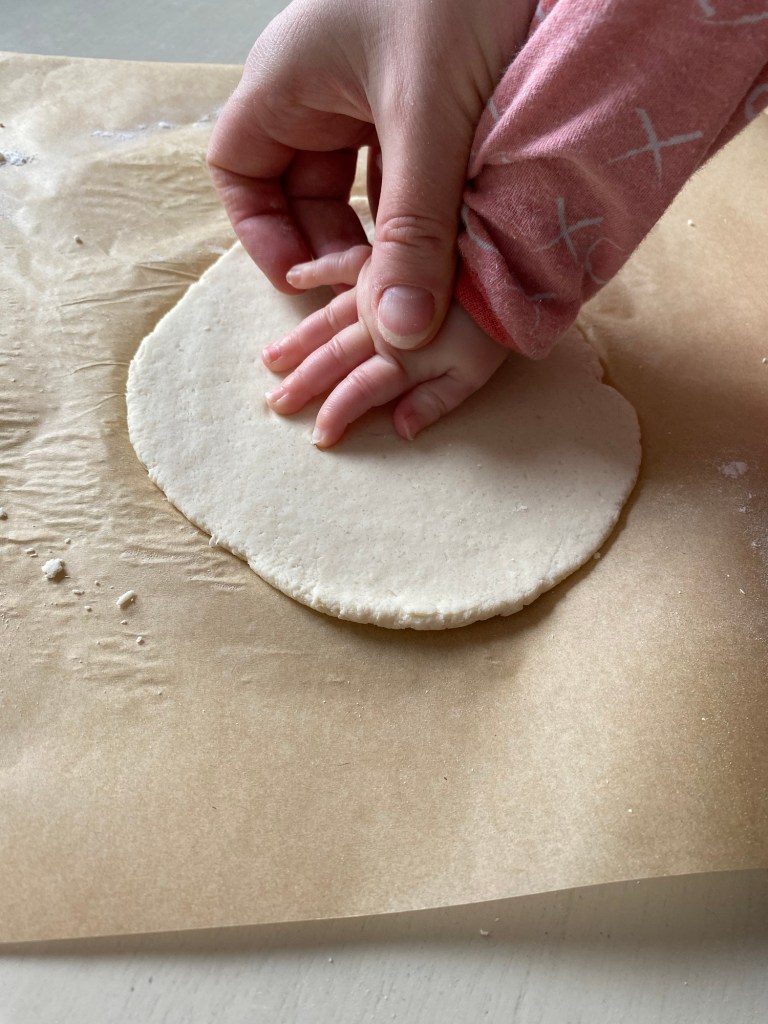
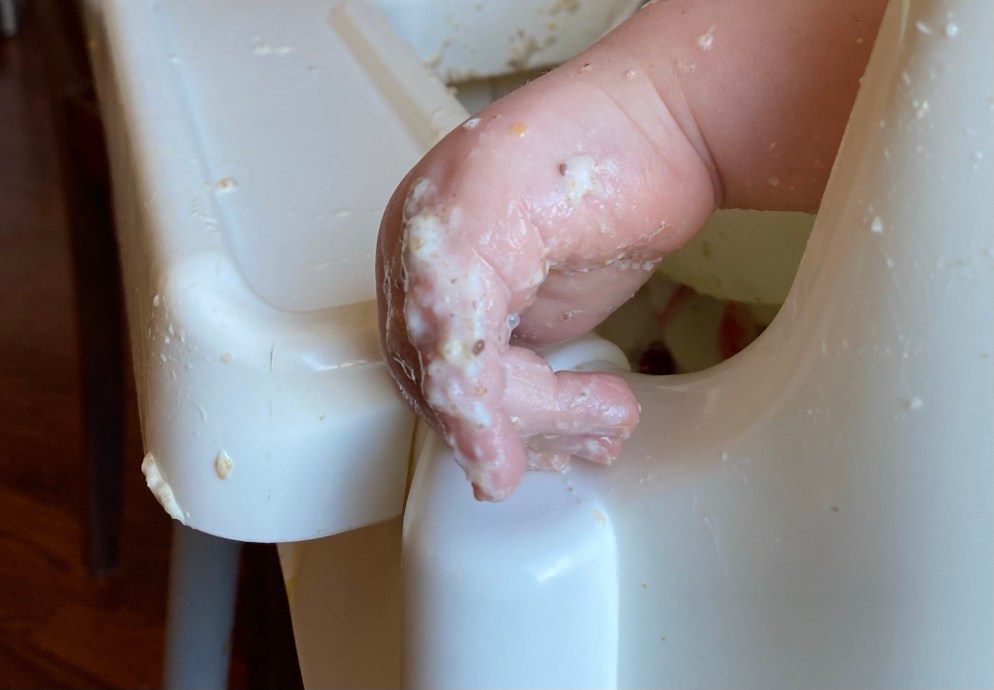
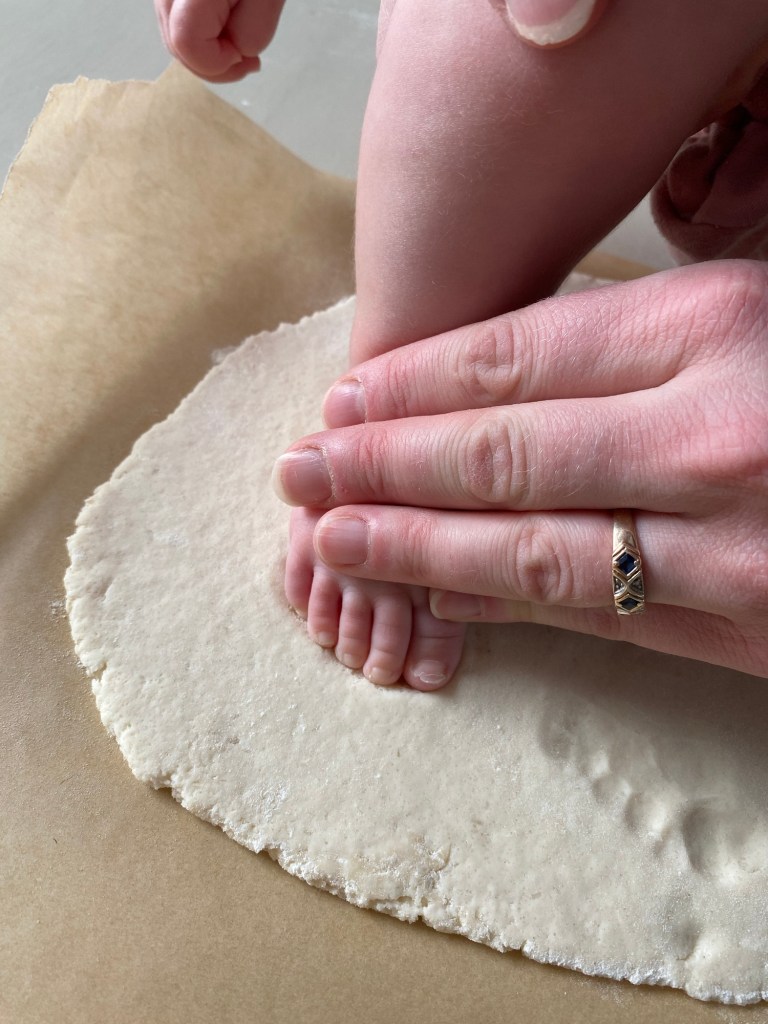
It’s not always easy to try to get wriggling toes or tiny squirming fingers to cooperate for this craft, so I definitely suggest having someone help hold your little one still while you gently push their feet or hands into the rolled out and ready dough!
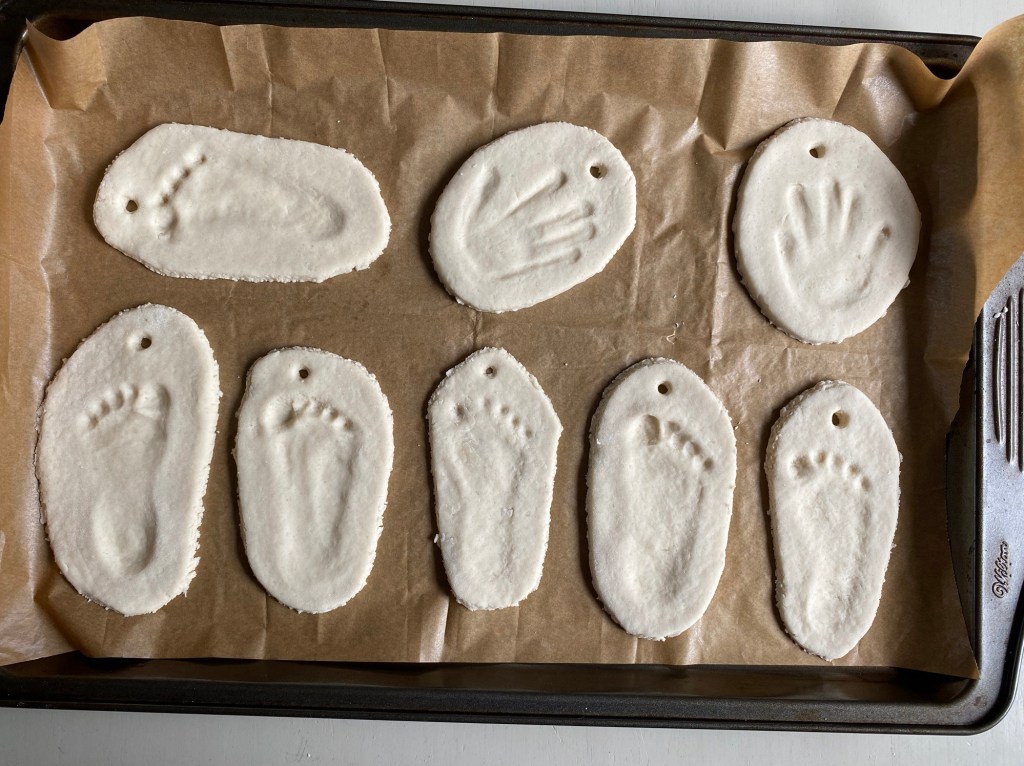
These charming ornaments also make great gifts for grandparents, aunties, uncles (to my family members reading this: sorry for the spoiler this year!) and other special friends in your life.

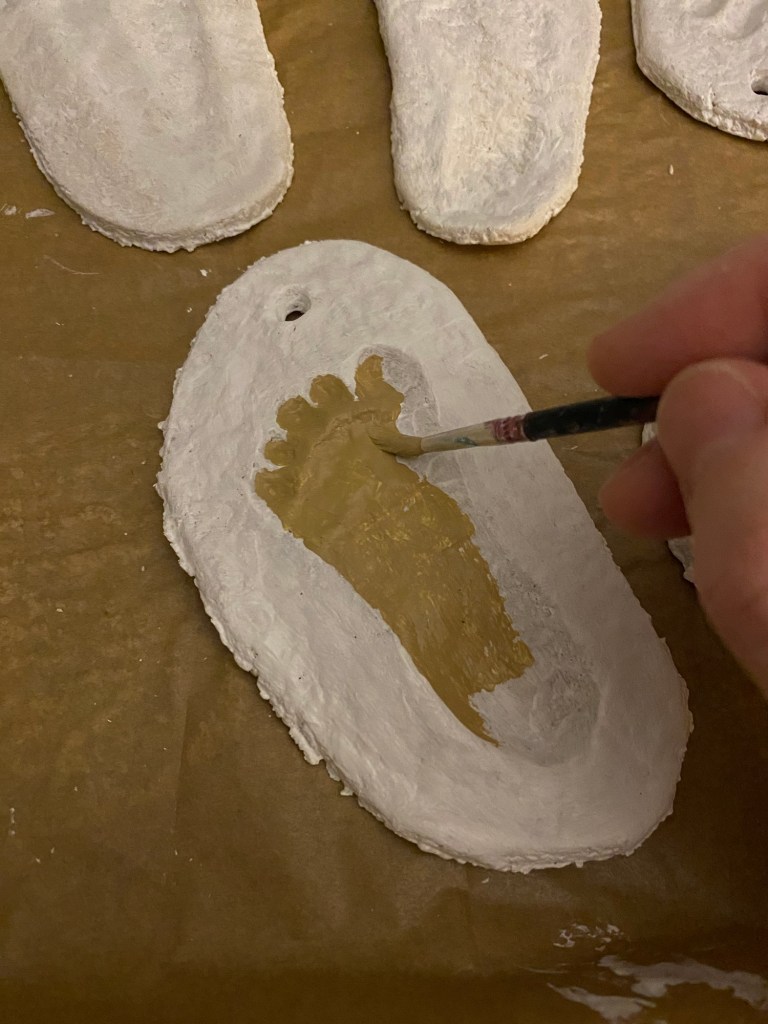
After baking them in the oven and cooling completely, use some acrylic paint to either paint the print so you can see it better, or paint the whole thing however you like!

After the paint has dried, a nice layer of mod podge will seal it and give it a nice shine to enjoy on your Christmas tree for many years to come.
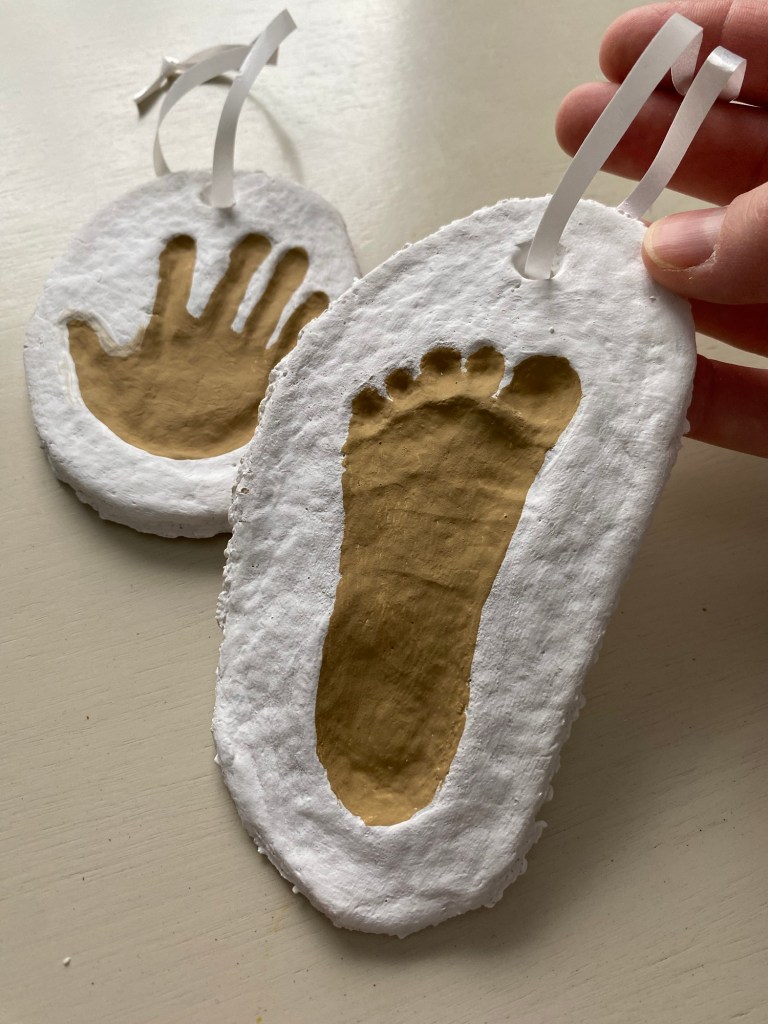
I hope you enjoy making this simple and inexpensive yet precious keepsake of this time in your baby’s life!

If you are a visual learner like I am, this video might be helpful to see the whole process!

How to Make Salt Dough Baby Foot/Handprint Ornaments:

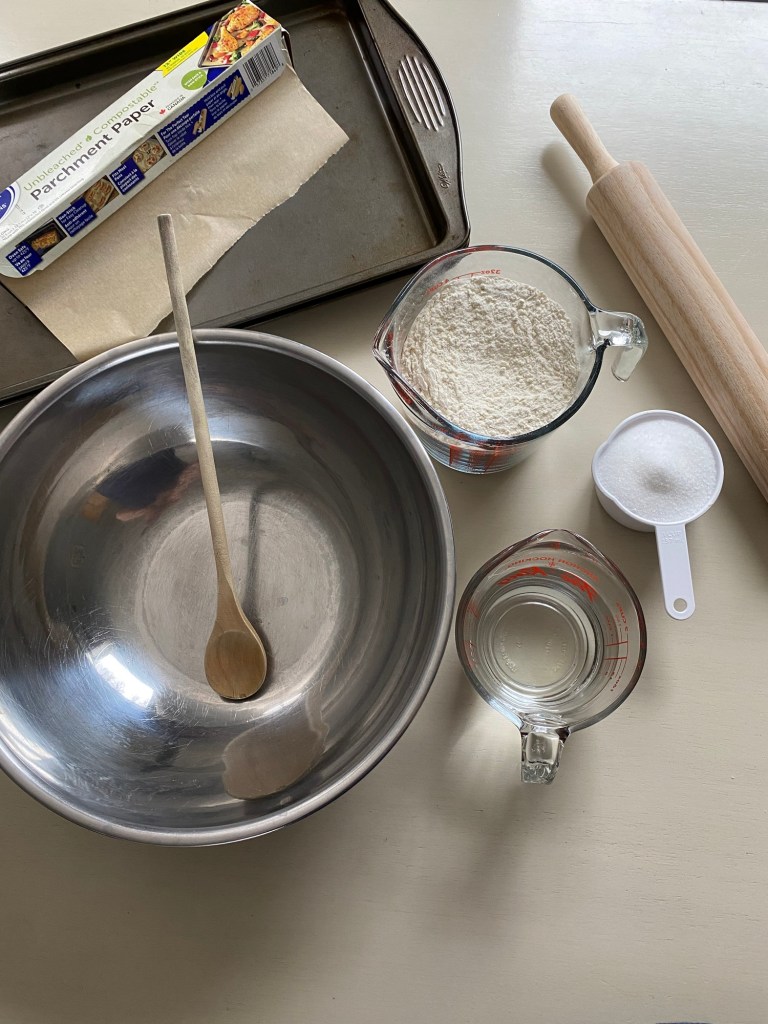
Supplies Needed:

Ingredients:

Directions:

  1. Preheat oven to 250 degrees fahrenheit.
  2. Mix flour and salt together in medium size bowl. (Add any additional sparkles or cinnamon if you want at this point, but keep in mind if you want to paint later on it may not matter too much!)
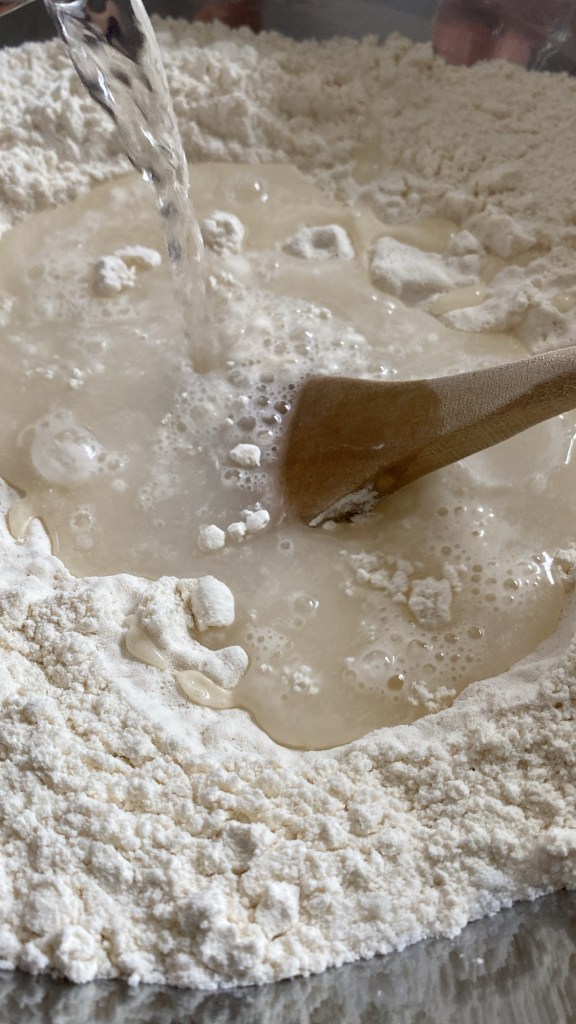
  3. Add just enough water to make it into a soft dough.
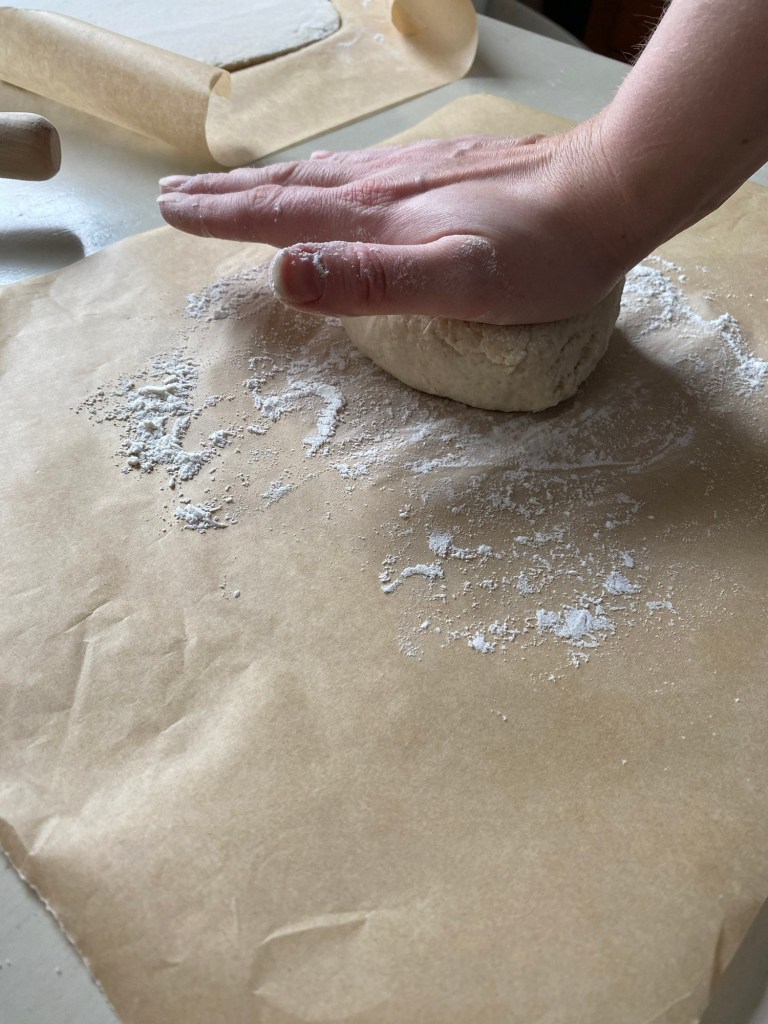
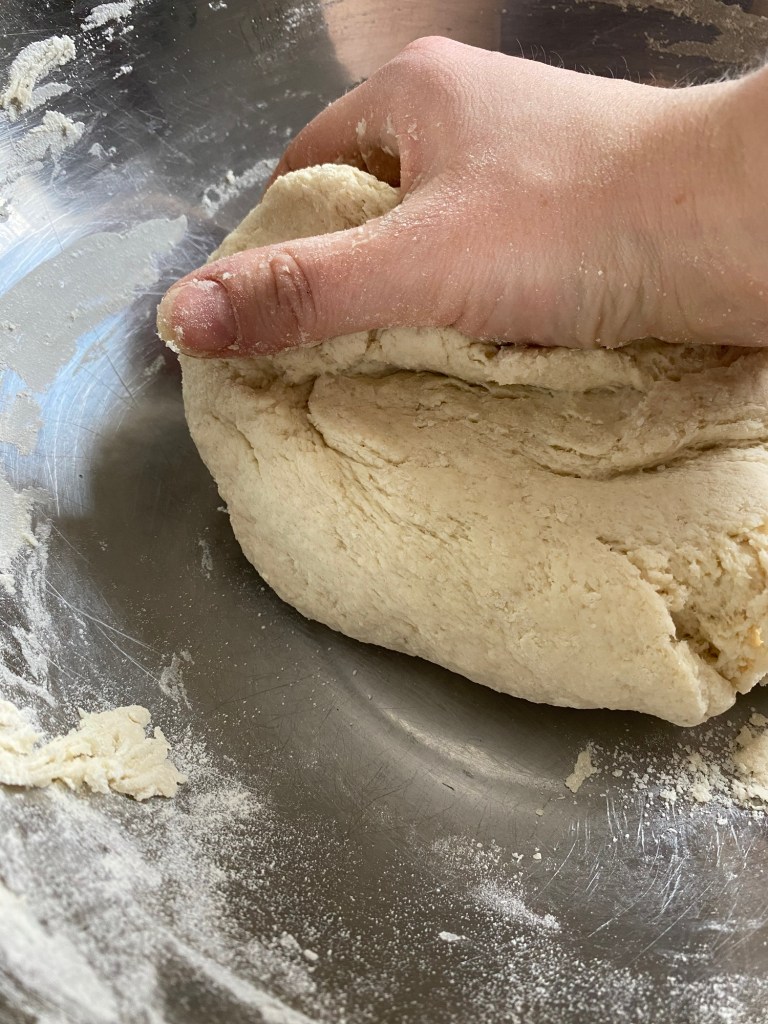
4. Knead for 2-3 minutes so dough is a smooth ball.

5. Divide into 2 balls and roll out to 1/4” thick (or about 1/2 centimeter). *You can try putting a flattened ball between two sheets of parchment paper with flour and rolling it this way, or just flour up a surface and roll out, adding flour as you go. (Try not to add too much flour, just enough so that it doesn’t stick to the parchment or pin!)

6. While baby is held overtop of dough area by one person, another can gently take the hand or foot and press firmly into the soft dough. Make sure to poke each finger and toe so that you get the full imprint! (If you have a really wriggly baby, feet are definitely much easier to do than hands!)

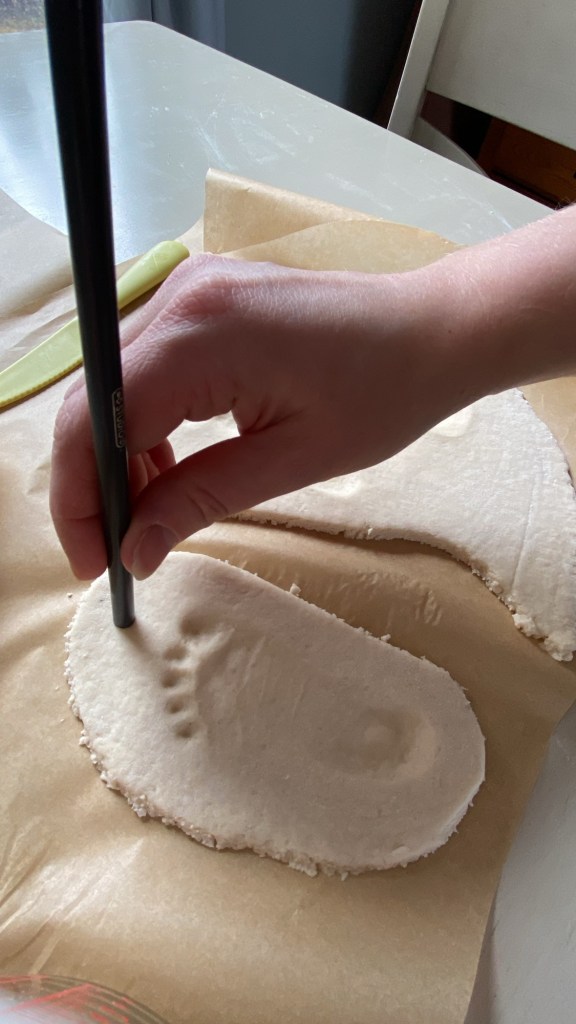
7. If the print is not very deep, it will be harder to see, especially after baking. Use your finger or gently use a utensil to deepen the baby’s print to make it more visible.

8. Use dull knife or large cookie cutter to cut out baby’s print. Gently place on a parchment covered baking sheet, spaced out evenly with other baby prints.

9. Poke a hole above the print for the ribbon, leaving at least 1/2 inch of dough before the edge.

10. Bake on middle rack for about 1.5-2 hours (90-120 minutes). The timing will largely depend on the thickness of the baby prints, so I recommend checking it after 1 hour, and every 20 minutes after that. When done it will be mostly hard yet slightly soft on top (not squish-able!) and slightly golden on bottom. Turn the oven off at this point and just let them continue to dry out in the oven for another hour (or longer if you want, just make sure not to forget about them for the next time you use the oven!)

11. Remove from oven and transfer to cooling racks.

12. When fully cooled (or the next day!) you can use acrylic paint if desired to paint the baby’s imprint area so it can be seen better, and decorate however you like. I also painted the backs once the front side had dried.

13. Seal with mod podge or other craft sealer to help it stay dry and preserved.

14. Don’t forget to write your baby’s name and age with a permanent marker so you don’t forget this precious moment in your baby’s life.

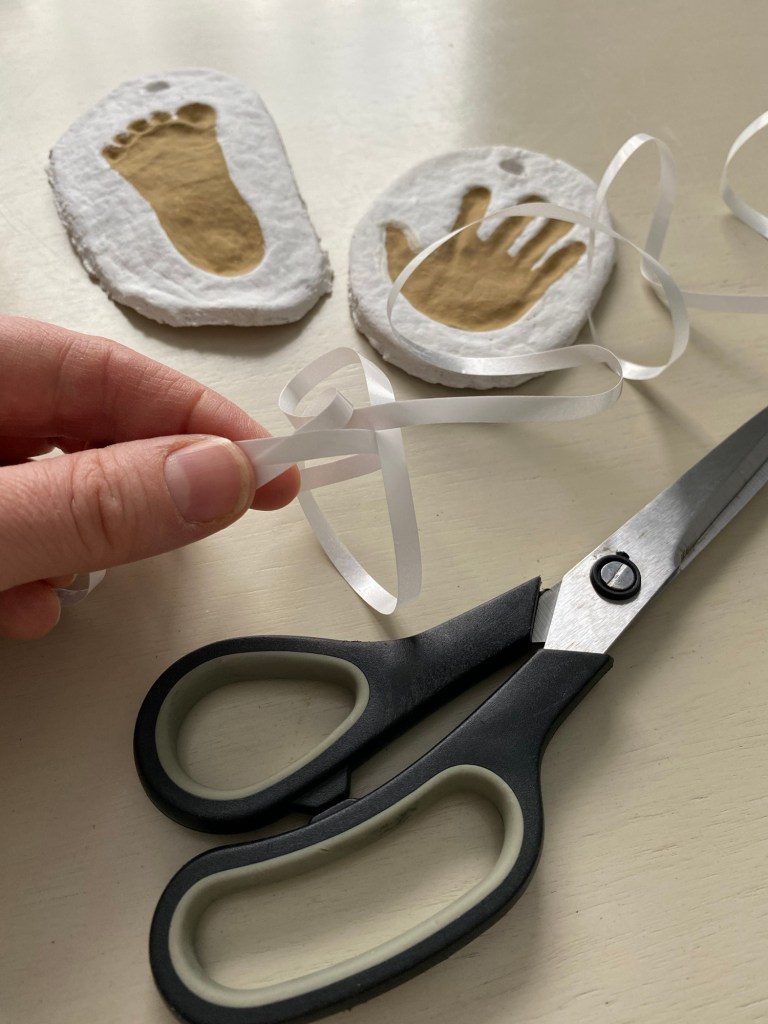
15. Tie with a ribbon and wrap up carefully when not in use. Keep in mind that it may still break if dropped (it is salt dough after all!).

Additional Notes:

1. This recipe makes enough for about 10 handprint or footprint infant ornaments.

2. I had some ornaments puff up while being baked several years ago, using other recipes. So after tweaking it and having many great results, I have learned that puffing up usually happens from these three avoidable things:

  • Having the oven too hot
  • The dough hasn’t been rolled out thin enough
  • The dough has mini air pockets in it

Made This Recipe?

I’d LOVE to see your results!! Feel free to post to your social media account and tag Northbird using one of these links:

Hi, I’m Jessie!

I’m a Wife and Homeschooling Mom living in a remote town in Northern Ontario, Canada. I love making wholesome meals for my family from scratch, homeschooling our girls and learning more about natural living.

Read more about my story HERE.

Subscribe to Northbird’s email list to get weekly posts on: tasty recipes, activity ideas for kids, natural living tips, and some genuine mom thoughts and encouragement!

Salt Dough Baby Footprint Ornaments

  • Servings: 10
  • Difficulty: Easy
  • Print

Make a salt dough imprint of your baby's hands or feet and turn it into a beautiful ornament or precious gift for your loved ones this Christmas!


This recipe makes enough for about 10 handprint or footprint infant ornaments.

Supplies Needed

  • Mixing bowl
  • Spoon
  • Measuring cups
  • Parchment paper
  • Rolling pin
  • Baking sheets x2
  • Cooling rack
  • Pencil or straw (for poking ribbon holes)
  • Dull knife or a large cookie cutter (if you want perfectly round ones!)

  • Ingredients

  • 2 cups all purpose flour (plus extra for rolling out)
  • 1/2 cup iodized fine salt
  • 3/4 cups water (more or less)
  • Additional ideas if not painting:

  • Directions

    1. Preheat oven to 250 degrees fahrenheit.
    2. Mix flour and salt together in medium size bowl. (Add any additional sparkles or cinnamon if you want at this point, but keep in mind if you want to paint later on it may not matter too much!)
    3. Add just enough water to make it into a soft dough.
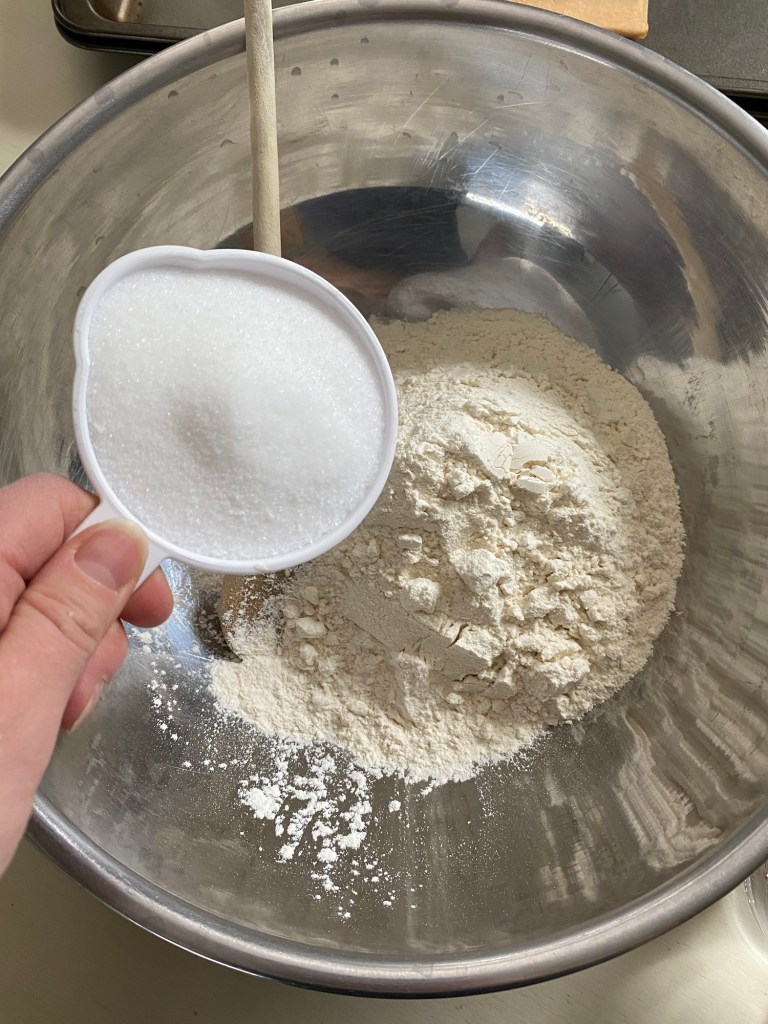
    4. Knead for 2-3 minutes so dough is a smooth ball.
    5. Divide into 2 balls and roll out to 1/4” thick (or about 1/2 centimeter). *You can try putting a flattened ball between two sheets of parchment paper with flour and rolling it this way, or just flour up a surface and roll out, adding flour as you go. (Try not to add too much flour, just enough so that it doesn’t stick to the parchment or pin!)
    6. While baby is held overtop of dough area by one person, another can gently take the hand or foot and press firmly into the soft dough. Make sure to poke each finger and toe so that you get the full imprint! (If you have a really wriggly baby, feet are definitely much easier to do than hands!)
    7. If the print is not very deep, it will be harder to see, especially after baking. Use your finger or gently use a utensil to deepen the baby’s print to make it more visible.
    8. Use dull knife or large cookie cutter to cut out baby’s print. Gently place on a parchment covered baking sheet, spaced out evenly with other baby prints.
    9. Poke a hole above the print for the ribbon, leaving at least 1/2 inch of dough before the edge.
    10. Bake on middle rack for about 1.5-2 hours (90-120 minutes). The timing will largely depend on the thickness of the baby prints, so I recommend checking it after 1 hour, and every 20 minutes after that. When done it will be mostly hard yet slightly soft on top (not squish-able!) and slightly golden on bottom. Turn the oven off at this point and just let them continue to dry out in the oven for another hour (or longer if you want, just make sure not to forget about them for the next time you use the oven!)
    11. Remove from oven and transfer to cooling racks.
    12. When fully cooled (or the next day!) you can use acrylic paint if desired to paint the baby’s imprint area so it can be seen better, and decorate however you like. I also painted the backs once the front side had dried.
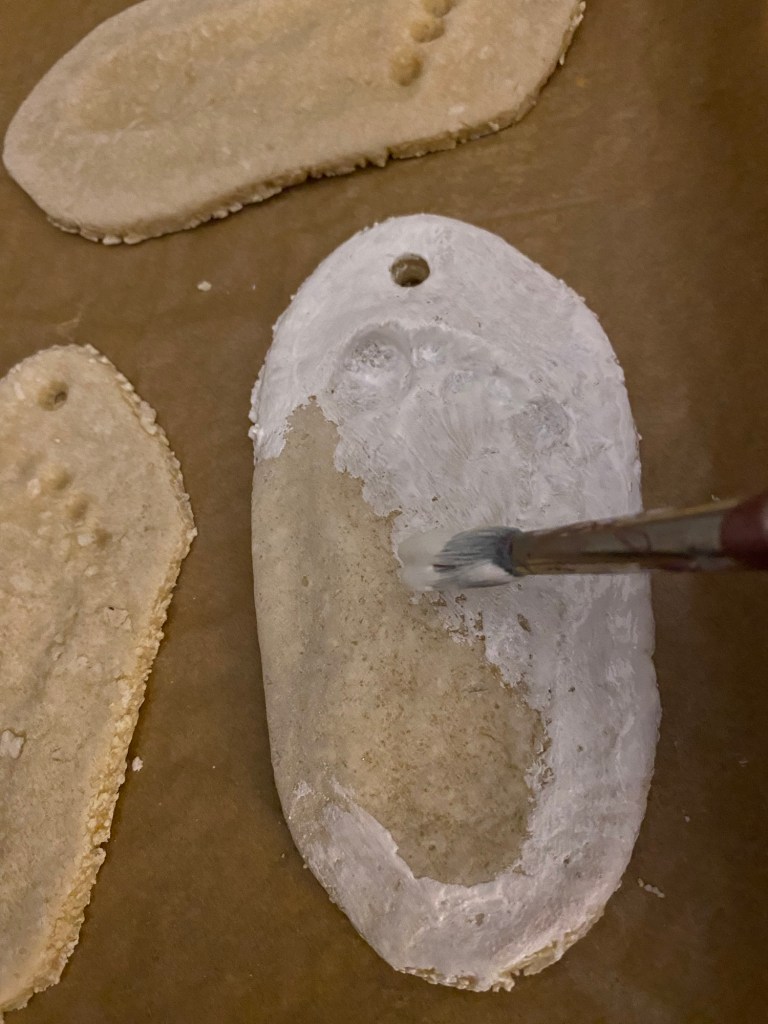
    13. Seal with mod podge or other craft sealer to help it stay dry and preserved.
    14. Don’t forget to write your baby’s name and age with a permanent marker so you don’t forget this precious moment in your baby’s life.
    15. Tie with a ribbon and wrap up carefully when not in use. Keep in mind that it may still break if dropped (it is salt dough after all!).
    Return to Top

    Exploring Salt Water Density: Homeschooling Egg Experiment

    Find Northbird on social media:

    This post contains affiliate links. As an Amazon associate, I earn from qualifying purchases. This means that I make a small commission at no extra cost to you. You can read my full disclosure HERE.

    Jump to Printable Activity Card

    Jump to Video

    Return to “Homeschooling Activities & Resources”

    Return to “Ocean Life”

    What is density?

    Why do some things float in water and others sink? It all comes down to density.

    Density is the measurement of how compact an item is. If an item generally feels heavy, then it has high density, and if an item feels light then it has low density.

    For example, a rock has high density and will sink when you throw it in the water. But if you throw a dry stick in the water, it will float because the particles that make it up are more spread apart, and it is less dense than the water.

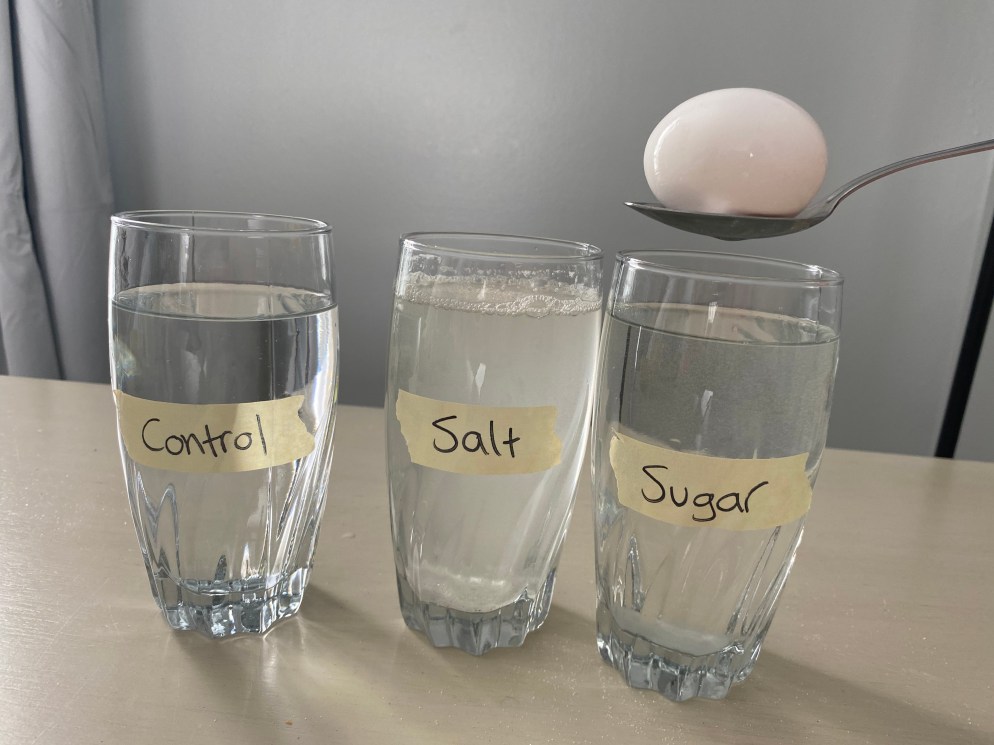
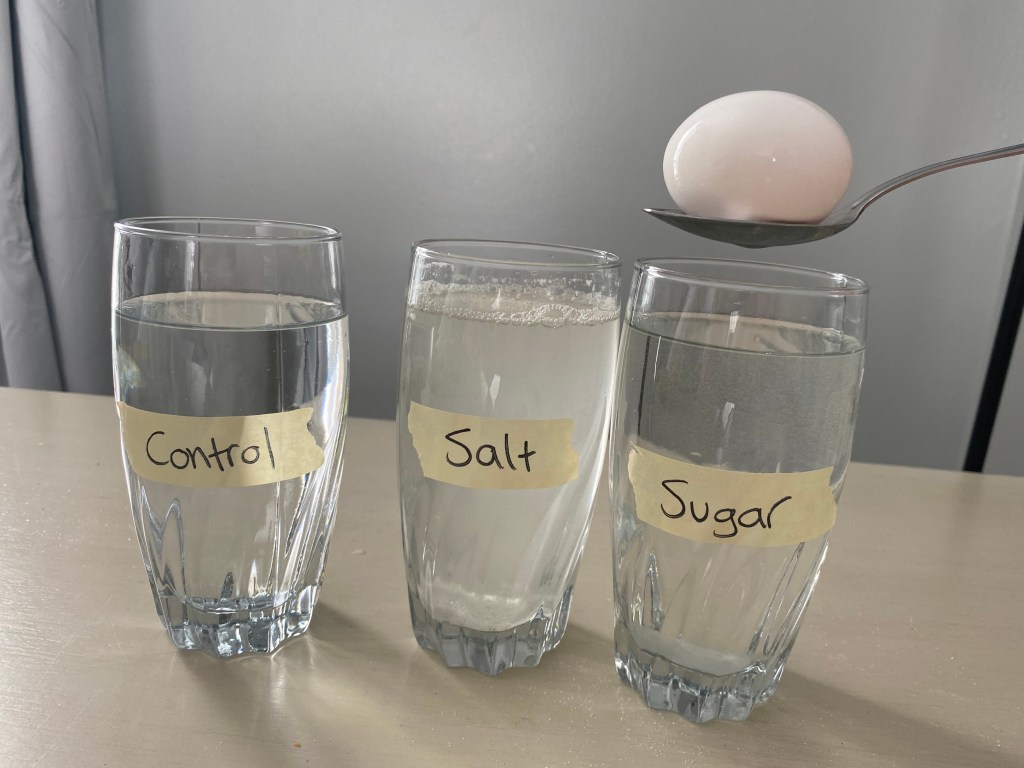
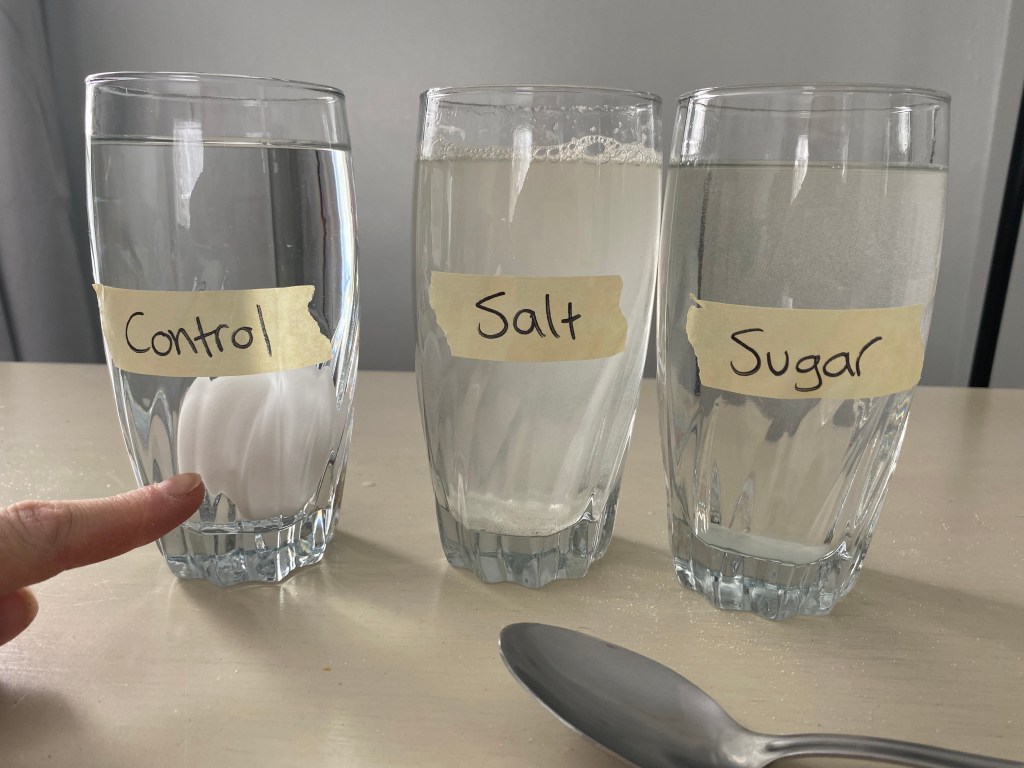
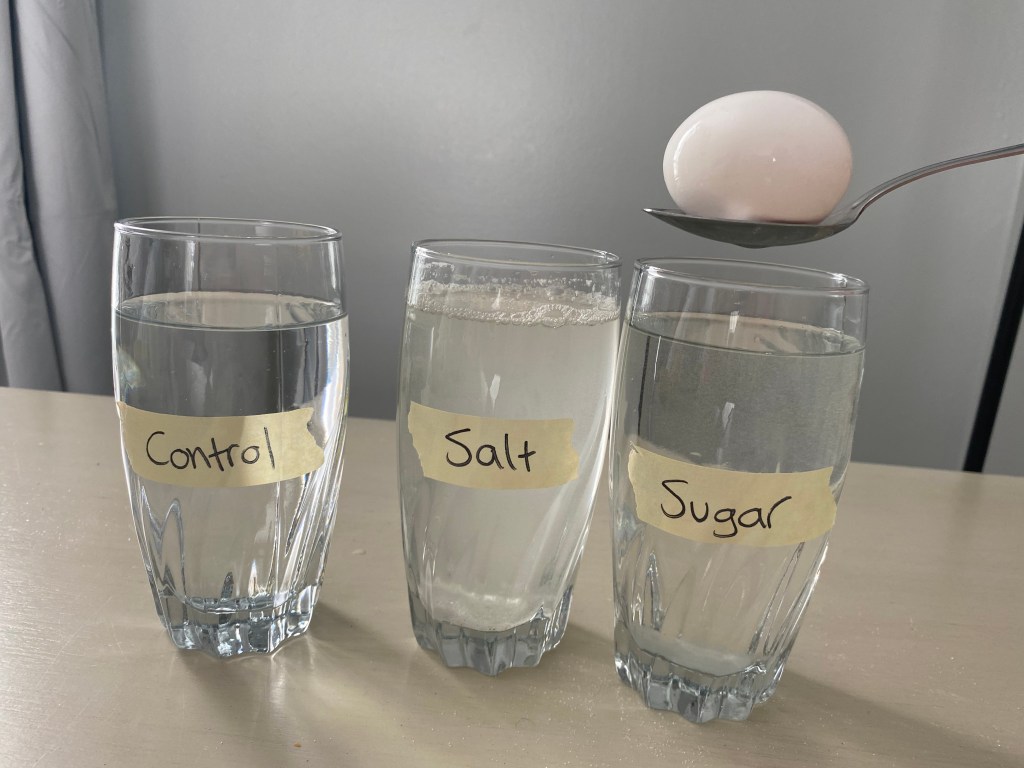
    We did a little experiment at home to test the buoyancy of an egg when first submerged in water, then sugar water, then lastly in salted water. This was to test the different levels of density in each of these water glasses, and compare it to the egg’s own density.

    This was my oldest’s first time learning about density and salinity. She was quite baffled that we were actually able to make the egg float!

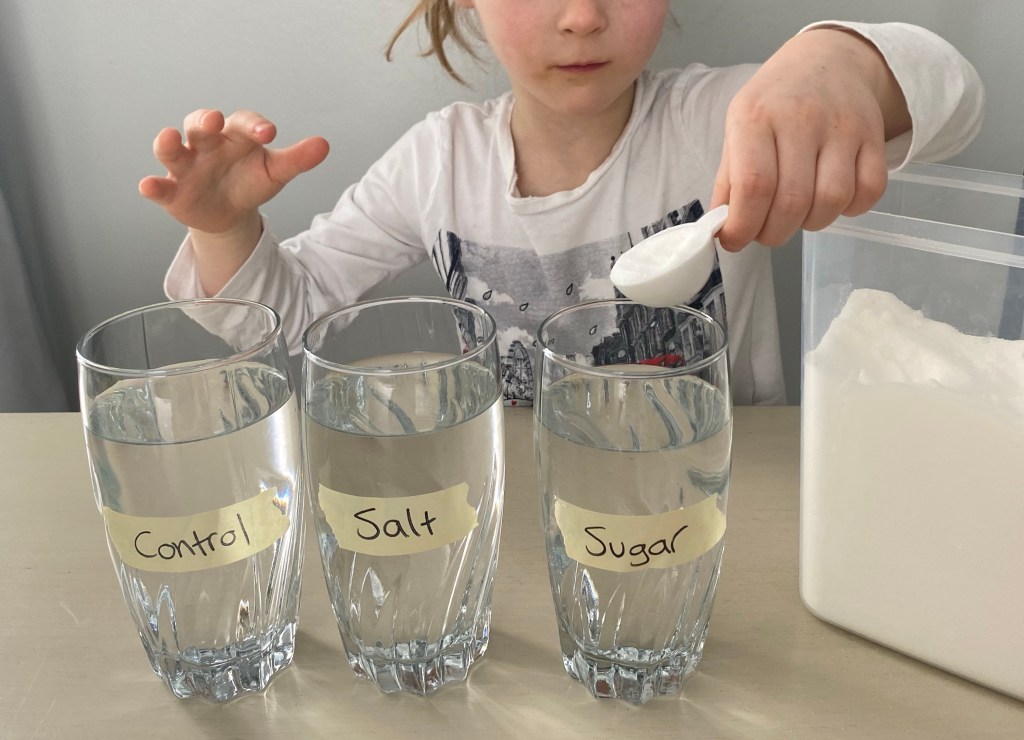
    (My toddler’s favourite part was watching the glasses be stirred and the sugar and salt getting dissolved!)

    Check out the directions below to do this yourself at home!

    Here’s a short video of the process and the kid’s delight in seeing the egg bobbing in the glass!

    Egg Density Experiment:

    Supplies Needed:

    Directions:

    1. Fill the 3 glasses with equal amounts of cold water.
    2. Label each glass: 1-Control, 2-Salt, 3-Sugar.

    3. Put 8 Tablespoons of table salt in the “Salt” glass and stir well until dissolved.

    4. Put 8 Tablespoons of granulated sugar in the “Sugar” glass and stir well until dissolved.

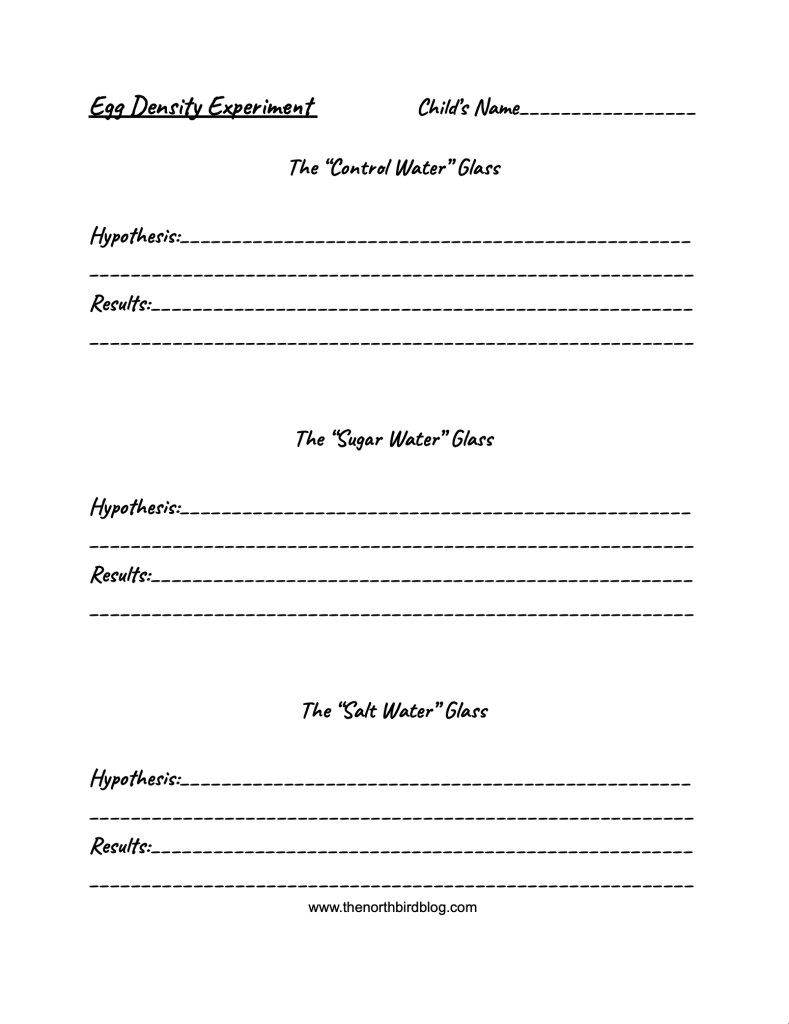
    5. Ask the kids what they think will happen. They can write their “hypothesis” in the attached PDF printable at this point.

    6. Place egg carefully in the “Control” glass (you might want to use the spoon to lower it in…!)

    7. Then put egg in the “Sugar” glass, followed by the “Salt” glass, and see the results! If easier, use two eggs for these glasses to compare the egg’s buoyancy.

    8. Document your findings and compare your results to the hypothesis made earlier. See if you guessed right or were surprised!

    Our Findings:

    We discovered that in the “Control” glass of water, the egg was more dense than the water, so it sank.

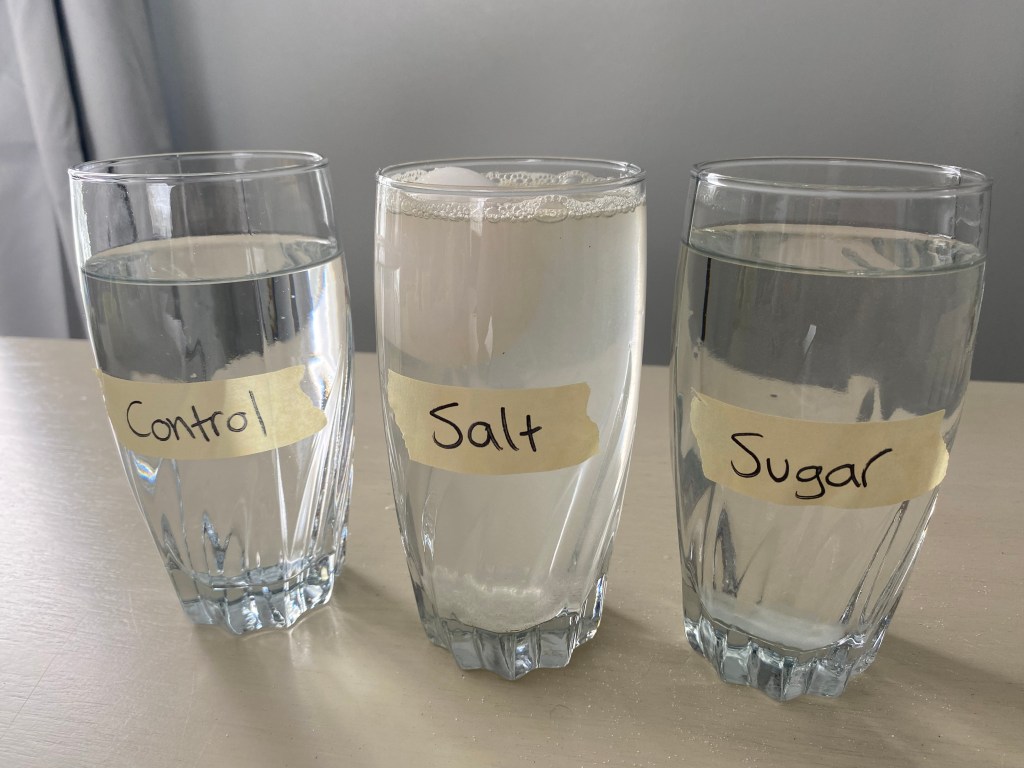
    The “Sugar” glass of water was more dense than the “Control” water, but not more dense than the egg, so the egg lifted a bit in the water but didn’t float on the surface.

    The “Salt” glass of water had the highest density. We discovered that when the egg was put in it, it floated on the water’s surface. This showed that the egg had a lower density than the salted water.

    Educational Videos

    “Why is it called “Dead Sea”? Why does everyone float in this sea?” by Science ABC

    This is a very detailed thorough video about the density of salt in the Dead Sea (Israel). They discuss why people can effortlessly float in it, and how there is such a high amount of salt in that particular body of water. This video is definitely geared toward older kids (my 6 year old’s eyes sort of “glazed over” after a few minutes in!)

    “Why is the Ocean Salty?” by Mystery Science

    This video is well done and designed to engage younger grades. It is full of questions that younger kids ask (at least ones that my oldest has asked me and I had no idea the answer to!).

    I love how there is also a part where they recommend pausing the video to discuss with the kids “Why do you think the ocean is salty but lakes and rivers aren’t?”

    Sink or Float?” by SciShow Kids

    This cute video discusses the topic of density and how the density of different items compare with the density of water. There is a simple experiment that you can do at home alongside the video so that younger kids can test this concept out for themselves. The conclusion of the study is communicated clearly, making it easy for younger kids to understand the concept of density.

    Other posts on Ocean Life:

    Hi, I’m Jessie!

    I’m a Wife and Homeschooling Mom living in a remote town in Northern Ontario, Canada. I love making wholesome meals for my family from scratch, homeschooling our girls and learning more about natural living.

    Read more about my story HERE.

    Subscribe to Northbird’s email list to get weekly posts on: tasty recipes, activity ideas for kids, natural living tips, and some genuine mom thoughts and encouragement!

    Exploring Salt Water Density: Homeschooling Egg Experiment


    Supplies Needed

  • 3 tall glasses
  • 6 Tablespoons of table salt
  • 6 Tablespoons of granulated sugar
  • An egg
  • A spoon
  • Label & marker
  • PDF printed experiment page

  • Directions

    1. Fill the 3 glasses with equal amounts of cold water.
    2. Label each glass: 1-Control, 2-Salt, 3-Sugar.
    3. Put 8 Tablespoons of table salt in the “Salt” glass and stir well until dissolved.
    4. Put 8 Tablespoons of granulated sugar in the “Sugar” glass and stir well until dissolved.
    5. Ask the kids what they think will happen. They can write their “hypothesis” in the attached PDF printable at this point.
    6. Place egg carefully in the “Control” glass (you might want to use the spoon to lower it in…!)
    7. Then put egg in the “Sugar” glass, followed by the “Salt” glass, and see the results! If easier, use two eggs for these glasses to compare the egg’s buoyancy.
    8. Document your findings and compare your results to the hypothesis made earlier. See if you guessed right or were surprised!

    Return to Top

    Create a Mini Coral Reef Craft

    Find Northbird on social media:

    This post contains affiliate links. As an Amazon associate, I earn from qualifying purchases. This means that I make a small commission at no extra cost to you. You can read my full disclosure HERE.

    Jump to Printable Activity Card

    Jump to Video

    Return to “Homeschooling Activities & Resources”

    Return to “Ocean Life”

    The diversity of ocean life has been so exciting to learn about in homeschooling this past year! One of our favourite topics has been to investigate coral reefs and explore what animals and plant life live in these colourful ecosystems.

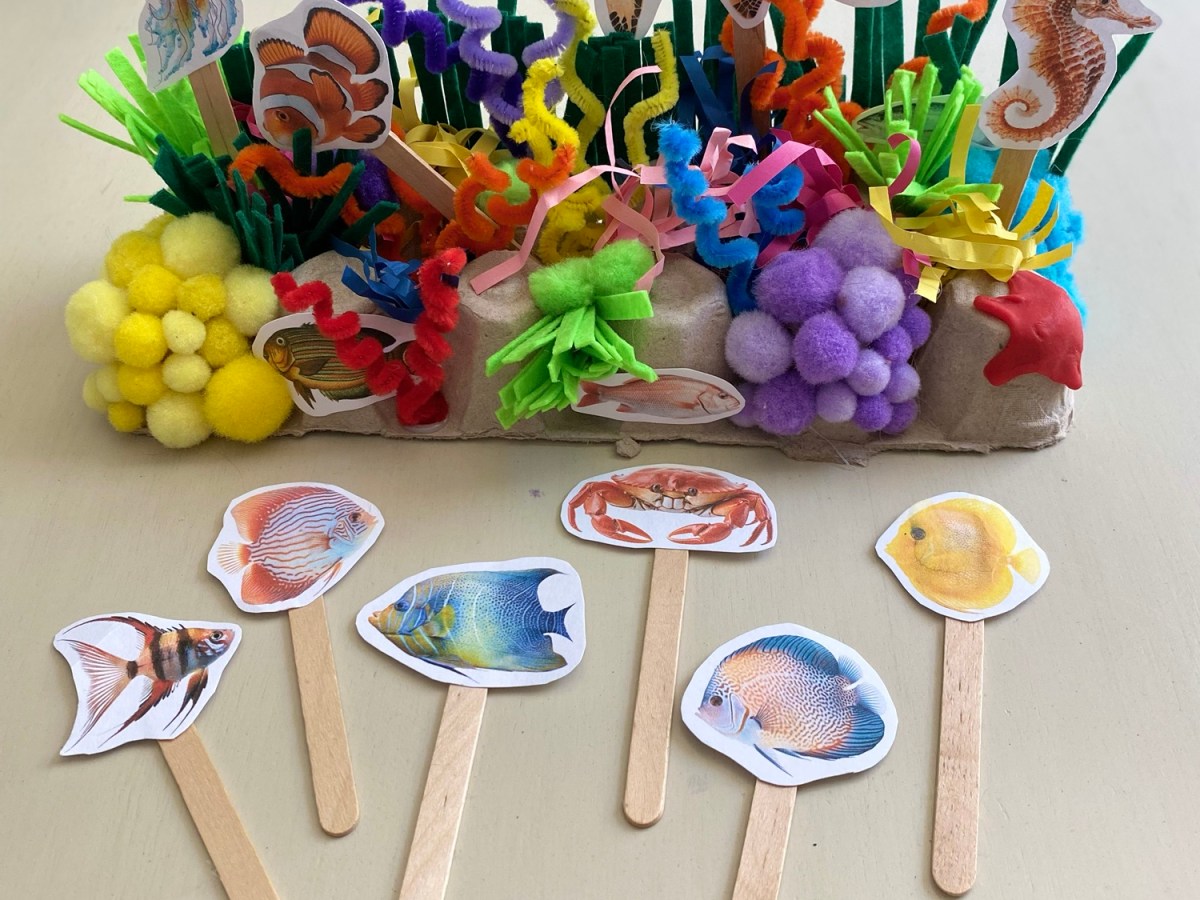
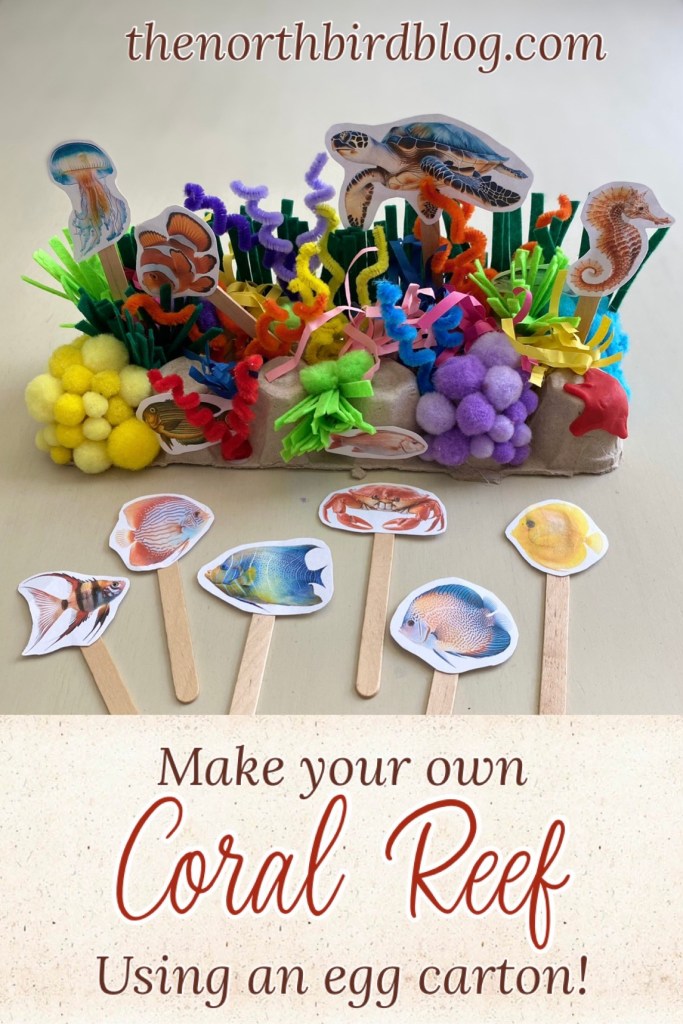
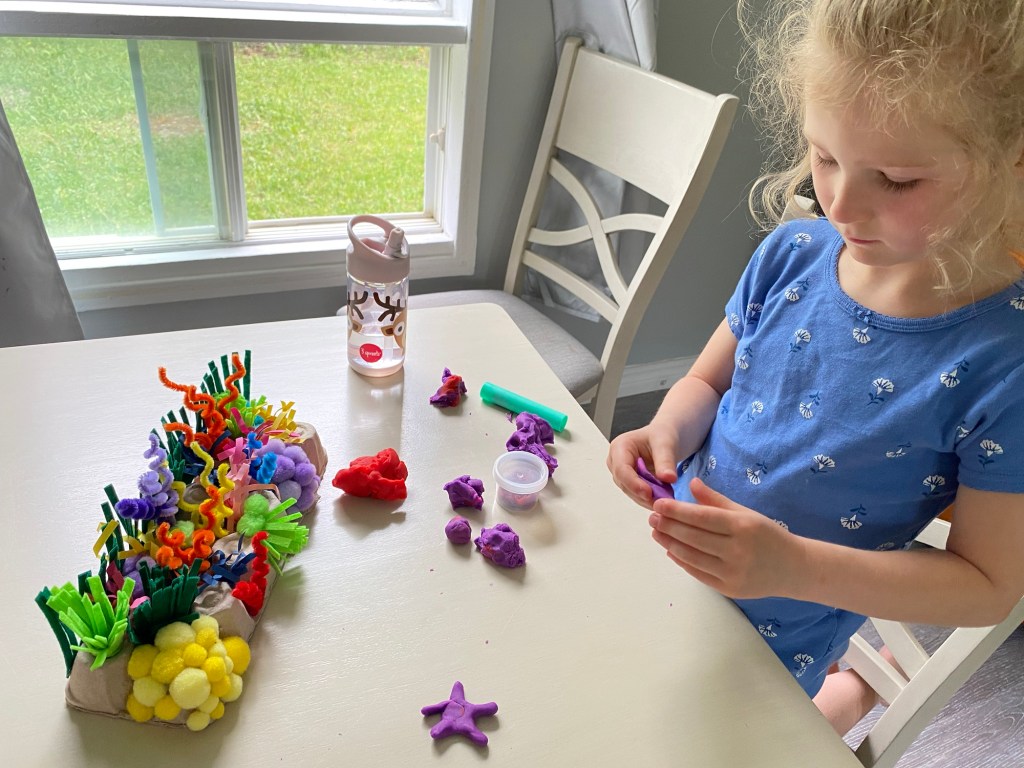
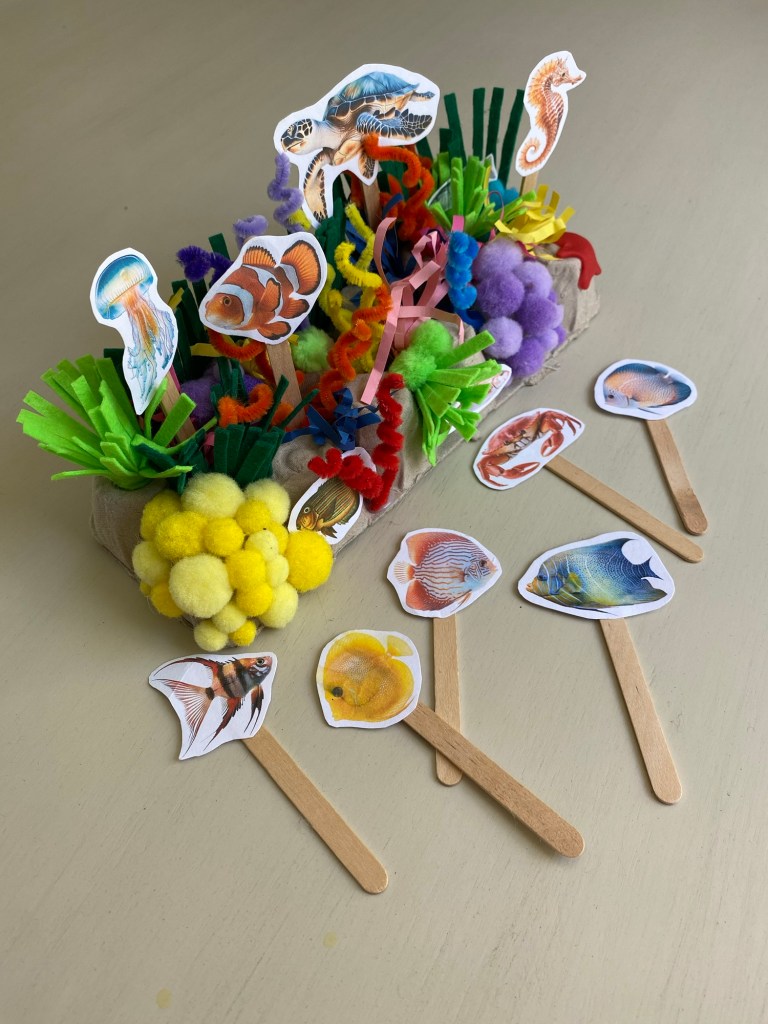
    We decided to try making our own mini coral reef and came up with this simple and fun craft!

    Aerial View of Great Barrier Reef, Image from Vecteezy.com

    About Coral:

    Did you know that coral is actually an animal?! I totally didn’t until my daughter and I started reading about it.

    Here are a few fun facts that you might not know about Coral:

    • They are invertebrates (a large class of animals that have no backbone)
    • They are in the same family as jellyfish and sea anemones (Cnidarians)
    • They have nerves and muscles but no brains or hearts
    • They are carnivores and eat mostly plankton and other small fish
    • They are divided into 2 categories: Hard and Soft Corals
    • They are naturally clear and void of any colour. Zooxanthellae, an algae lives in them and gives them their incredible colours
    • Some corals can even move from one location to another!
    • Corals are essential for cleaning the water. They are sometimes called the “rainforests of the sea”

    If you are looking for some inspiration before making your egg carton coral reef, this is a great video showing the beautiful underwater world of coral reefs:

    About This Craft:

    We really enjoyed putting this little craft activity together to make a mini replica of coral reefs. The kids liked exploring the different textures, colours and materials used, and then playing with the popsicle stick animals afterwards!

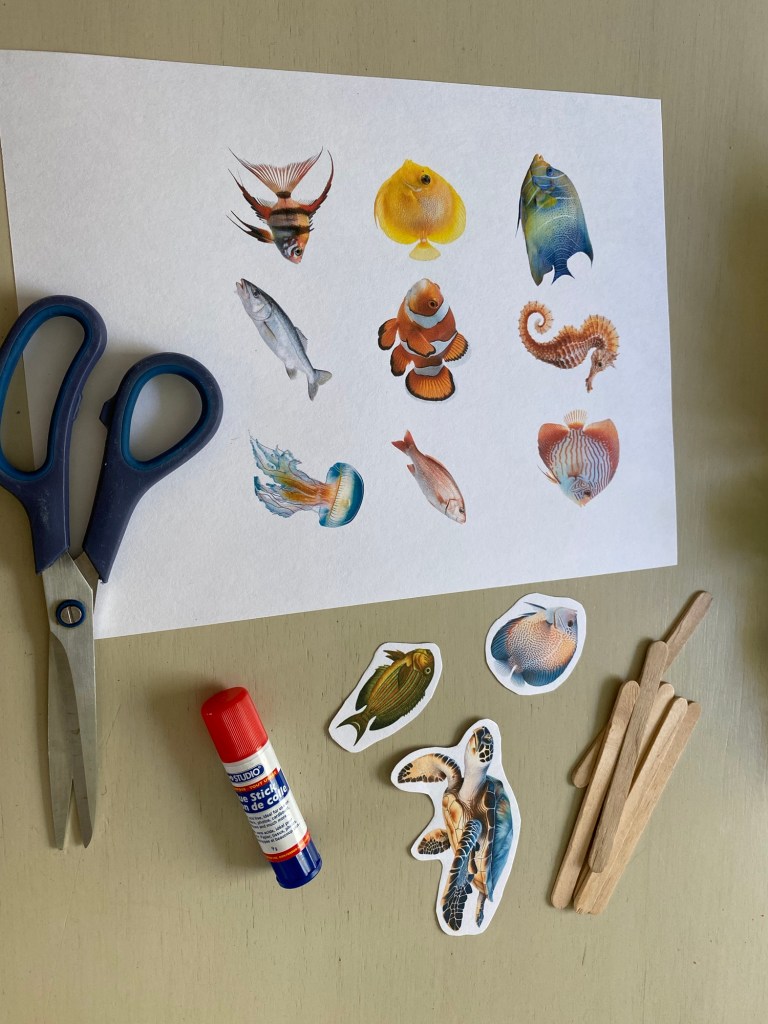
    This is the free printable of fish and animals commonly found on or around coral reefs.

    We cut them out and glued them to popsicle sticks to use as puppets around the egg carton reef.

    You can down load them HERE.

    This was a fun activity to have an excuse to look through our craft supplies and see what we could use to mimic the beauty and diversity of coral reefs. I’m sure yours will look much different from ours as this craft is largely based on what craft supplies are available and what your kids want their coral reef to look like.

    Have fun making this activity with your kids!

    Here’s a short video of making this crafted coral reef!

    How to Make an Egg Carton Coral Reef

    Supplies Needed:

    Directions:

    1. Cut egg carton in half and turn upside down.
    2. Paint or colour base if desired.
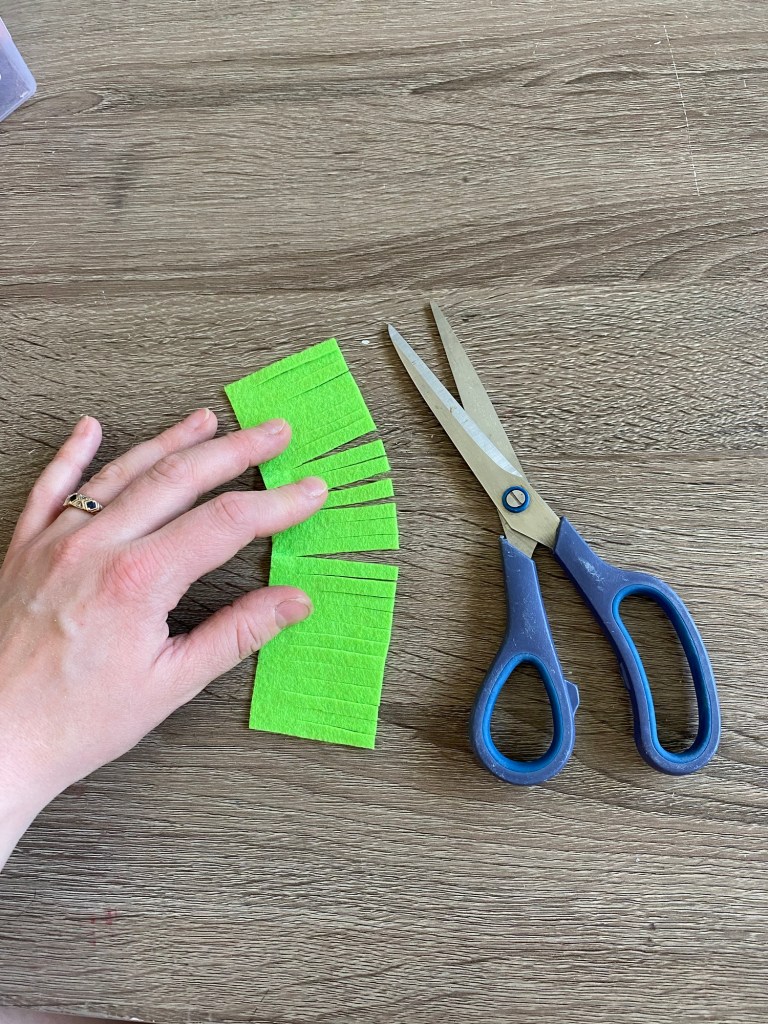
    3. Cut large strips of felt fabric or coloured paper, then cut slits into side as shown below (picture 1). Glue with hot glue gun to the back of the egg carton for seaweed.

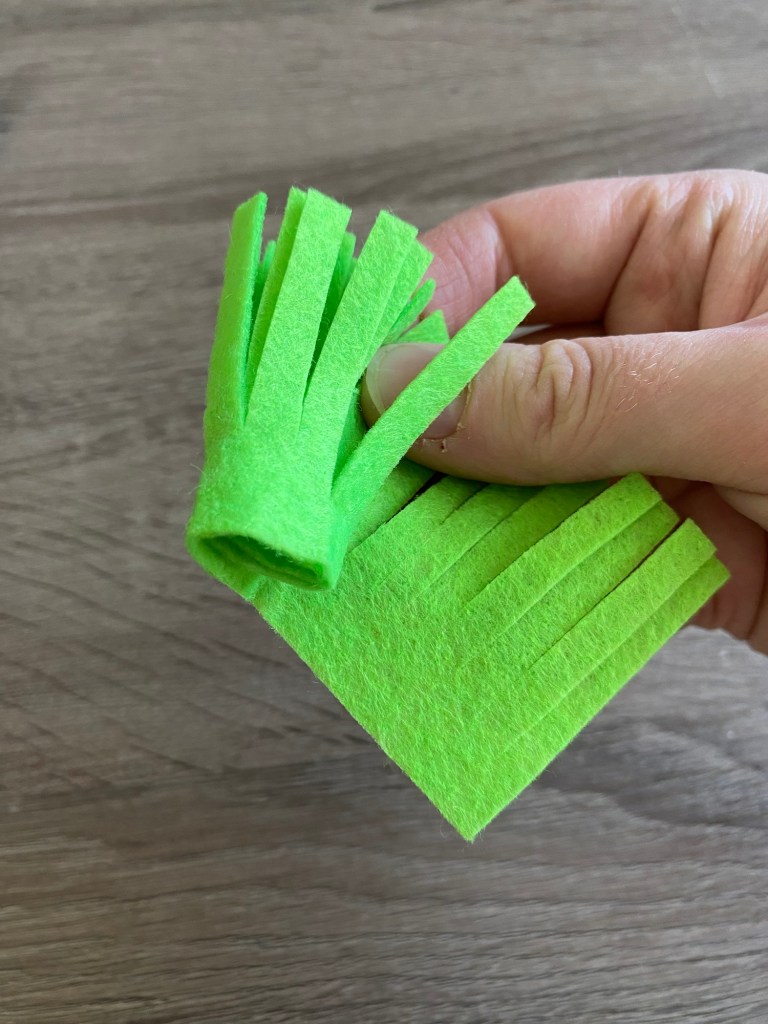
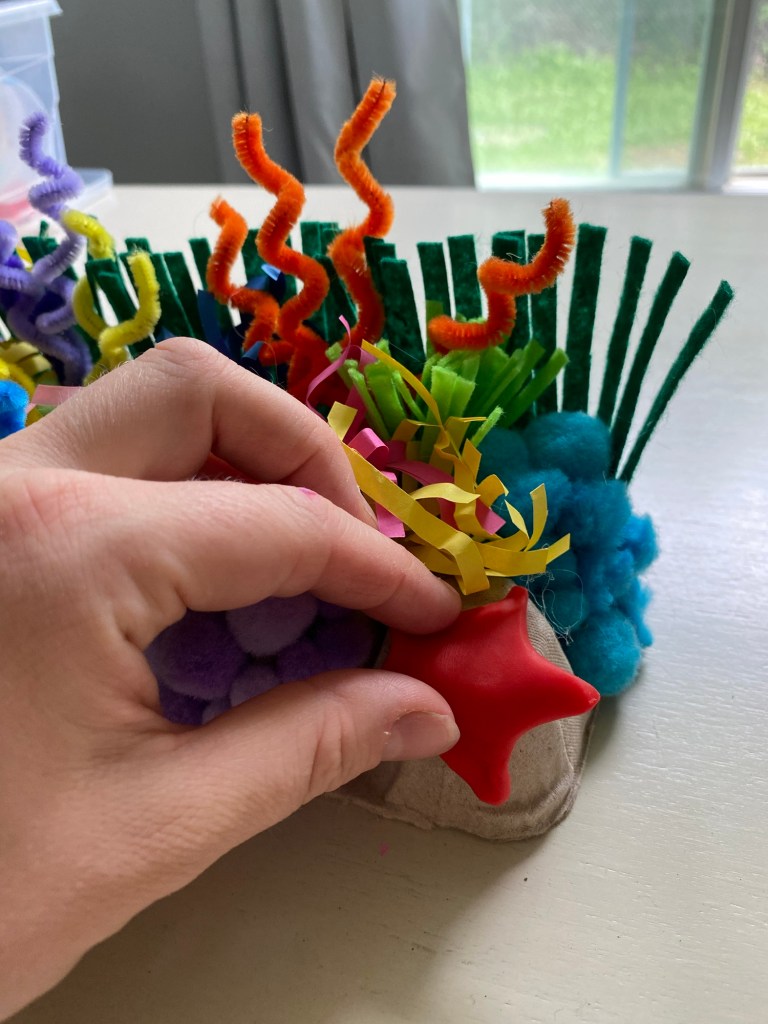
    4. Cut smaller strips of felt fabric or coloured paper, then cut slits into the side (same as picture 1). Roll and then glue the bottom side to wherever you would like on your coral reef.

    5. Swirl different coloured pipe cleaners around a pen or pencil to get another coral look (picture 3). Use hot glue gun to attach to egg carton base where desired.

    6. Use play dough to create other coral shapes or starfish or sand dollars and secure onto egg carton. We just molded the sea creatures and then let them dry right onto the egg carton.

    7. Decorate with pom-poms, beads, shells, or anything else you would like!

    8. Print the PDF of coral reef fish and sea creatures on white card stock paper, cut out and then glue with glue stick onto popsicle sticks.

    9. Let the kids have fun with imagination play as they learn about the different animals and sea creatures found living around coral reefs!

    Hi, I’m Jessie!

    I’m a Wife and Homeschooling Mom living in a remote town in Northern Ontario, Canada. I love making wholesome meals for my family from scratch, homeschooling our girls and learning more about natural living.

    Read more about my story HERE.

    Subscribe to Northbird’s email list to get weekly posts on: tasty recipes, activity ideas for kids, natural living tips, and some genuine mom thoughts and encouragement!

    Create a Mini Coral Reef Craft

    Use this fun craft to learn about the diversity and beauty of ocean life and make your own mini coral reef!


    Directions:

    1. Cut egg carton in half and turn upside down.
    2. Paint or colour base if desired.
    3. Cut large strips of felt fabric or coloured paper, then cut slits into side as shown below (picture 1). Glue with hot glue gun to the back of the egg carton for seaweed.
    4. Cut smaller strips of felt fabric or coloured paper, then cut slits into the side (same as picture 1). Roll and then glue the bottom side to wherever you would like on your coral reef.
    5. Swirl different coloured pipe cleaners around a pen or pencil to get another coral look (picture 3). Use hot glue gun to attach to egg carton base where desired.
    6. Use play dough to create other coral shapes or starfish or sand dollars and secure onto egg carton. We just molded the sea creatures and then let them dry right onto the egg carton.
    7. Decorate with pom-poms, beads, shells, or anything else you would like!
    8. Print the PDF of coral reef fish and sea creatures on white card stock paper, cut out and then glue with glue stick onto popsicle sticks.
    9. Let the kids have fun with imagination play as they learn about the different animals and sea creatures found living around coral reefs!

    Return to Top

    How to Make a Simple Bird Feeder

    Find Northbird on social media:

    This post contains affiliate links. As an Amazon associate, I earn from qualifying purchases. This means that I make a small commission at no extra cost to you. You can read my full disclosure HERE.

    Jump to Printable Activity Card

    Jump to Video

    Return to “Homeschooling Activities & Resources”

    Return to “Discovering Birds”

    “Birding” as a Homeschooler…

    With spring right around the corner, we are looking forward to many things, and one of those is more birds coming to visit!

    Many of our winter days have had temperatures around -30 to -40 degrees celcius, which means less feathery visitors to our bird feeders during those chilly days.

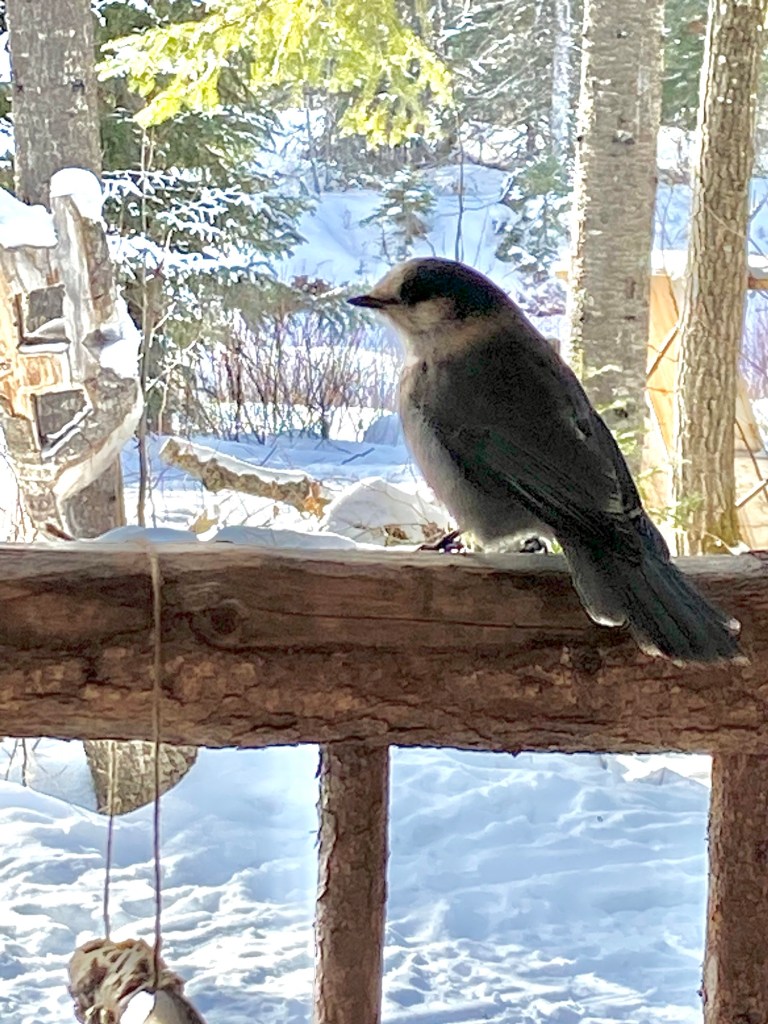
    However, through the winter we have still had a steady visiting flow of black-cap chickadees, whisky jacks, pileated woodpeckers, crows, and the occasional sparrow.

    Our kids love watching birds from our front window, and one of our favourite types of bird feeders is a clear plastic one (The Window Cafe, similar to THIS ONE) that suctions right onto the window glass! It lasted on our window for several months until we had several super cold days in a row, fell off and wouldn’t suction anymore…Oh well, we’ll try again when it’s warmer!

    A downy woodpecker hanging on to have a snack.

    When I was younger and also homeschooled, my mother kept several nature books in the sunroom (probably still does), and whenever an interesting bird, insect, or animal was spotted, out came the identification books to discover the name and nature of what we had found/observed.

    Of course, special mention must also go to my godfather “Ernie”, who was like a living, walking encyclopedia of knowledge. He was a retired science teacher and loved spending time with my siblings and I to teach and discover many things about the natural world around us. We didn’t even need to grab for our bird identification book if we were out on nature walks with him, we could just ask him! (Of course sometimes we got more information than we needed, such as the latin names and classification of species.)

    I’m sure Ernie will be mentioned on this blog more than once, as he was a very dear and memorable character, and had much knowledge and enthusiasm to offer young learners.

    About this Craft:

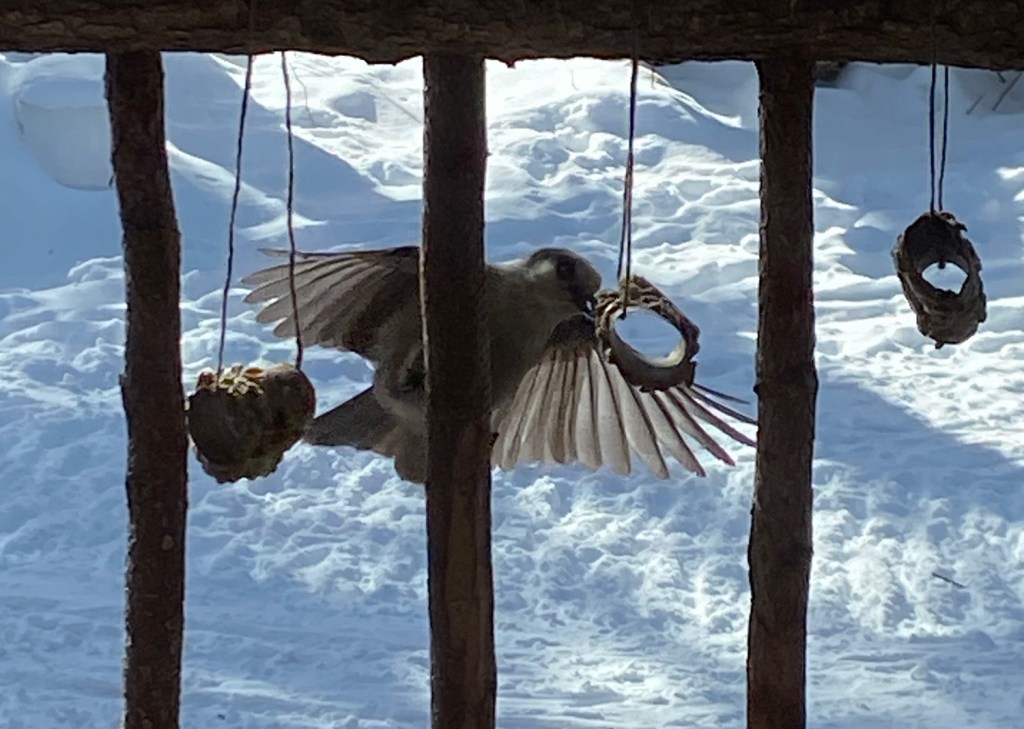
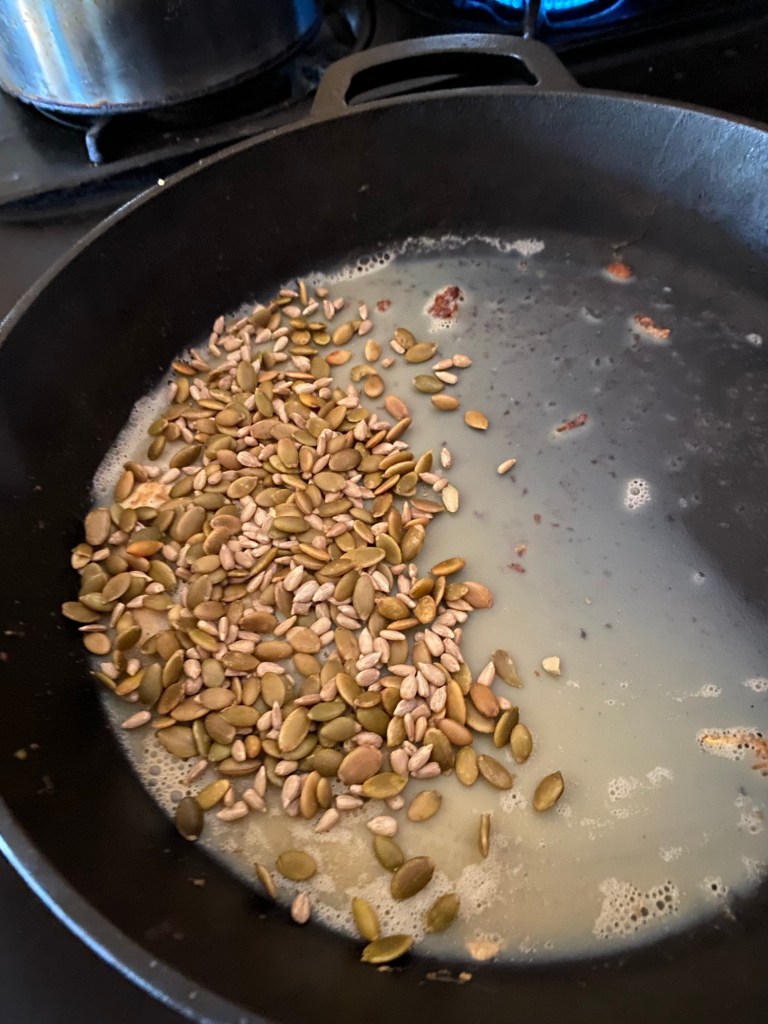
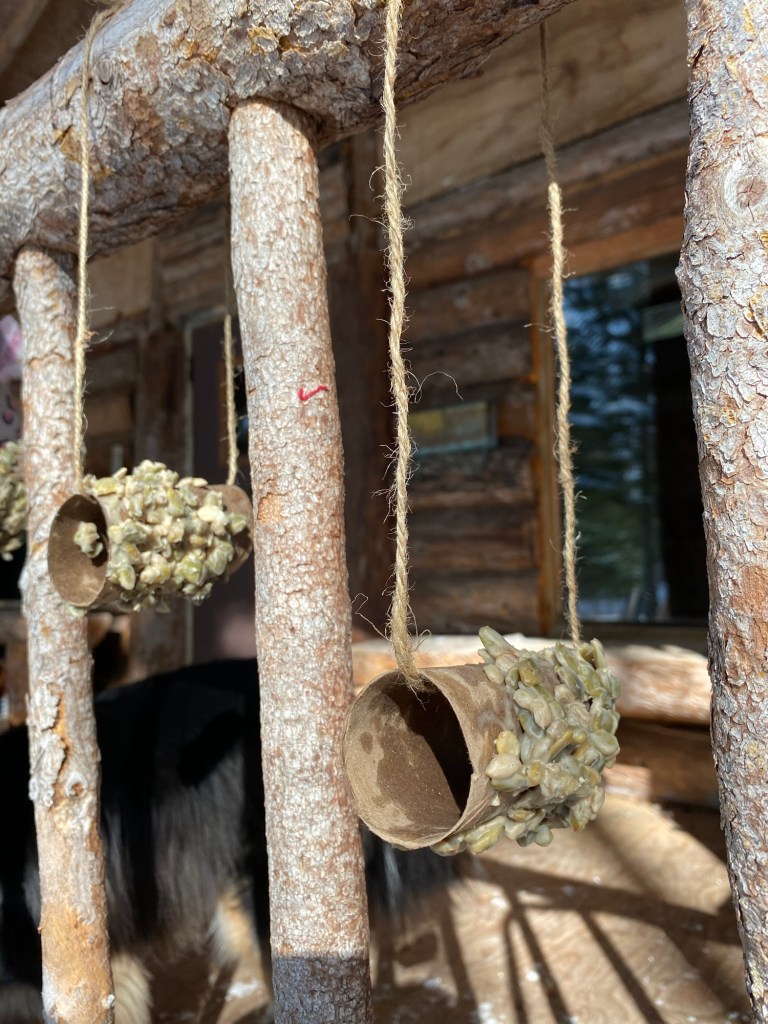
    On a recent family holiday weekend to a bush cabin, the kids and I developed this easy bird feeder idea, using leftover bacon grease and some sunflower and pumpkin seeds that I took from our trail mix. We spread the mixture onto a toilet paper finished roll, let it harden/freeze, then tied it to the porch railing. We had a lot of fun over the next few hours watching the whisky jack birds fight over our homemade bird feeders.

    A smart squirrel also noticed the tasty hanging treat and helped himself a few times. Eventually he figured out how to chew through the string and took off into the bush dragging the paper roll with him!

    Our pup may have snuck over a few times to sample the bacon grease…!

    There are many ways to make this simple bird feeder, based on what you may have available in your pantry. As I mentioned above, when we made it a few weeks ago we didn’t have any bird seed, just a few seeds in our trail mix that I sifted out. It would definitely be easier with smaller bird-feeder seeds!

    Have fun making this and don’t forget to watch and record what types of birds come to visit!

    Here’s a short video of making this easy bird feeder (and a few shots of the feathery/furry visitors that came to eat!)

    How to Make a Simple Bird Feeder

    Supplies Needed:

    • Leftover bacon grease (You can also use peanut butter, lard, or butter)
    • Bird seed
    • String
    • Scissors
    • Inside cardboard roll from toilet paper or paper towel rolls

    Directions:

    1. Pour seeds into pan of bacon grease and stir well. Let bacon grease cool in pan.

    2. Using a spoon, spread mixture onto paper roll. (Or, if your seeds are small enough, first spread grease/peanut butter onto paper roll and then dip/roll in a bowl of the bird seed.)

    3. Let harden on a plate if needed (we stuck ours outside in the BBQ overnight to fully harden without animals eating it!)

    4. Cut string to desired length (we used about 3 feet length), and thread through roll.

    5. Tie string ends to make a loop and hang near a window so you can watch the animal activity!

    Hi, I’m Jessie!

    I’m a Wife and Homeschooling Mom living in a remote town in Northern Ontario, Canada. I love making wholesome meals for my family from scratch, homeschooling our girls and learning more about natural living.

    Read more about my story HERE.

    Subscribe to Northbird’s email list to get weekly posts on: tasty recipes, activity ideas for kids, natural living tips, and some genuine mom thoughts and encouragement!

    How to Make a Simple Bird Feeder

    Looking for an easy craft for a homeschooling bird inquiry? Save that leftover bacon grease and toilet paper rolls to make your own hanging bird feeders!


    You can also use peanut butter, other nut butters, lard, or butter to replace the bacon grease.

    Supplies Needed:

  • Leftover bacon grease
  • Bird seed
  • String
  • Scissors
  • Inside cardboard roll from toilet paper or paper towel rolls
  • Directions:

    1. Pour seeds into pan of bacon grease and stir well. Let bacon grease cool in pan.
    2. Using a spoon, spread mixture onto paper roll. (Or, if your seeds are small enough, first spread grease/peanut butter onto paper roll and then dip/roll in a bowl of the bird seed.)
    3. Let harden on a plate if needed (we stuck ours outside in the BBQ overnight to fully harden without animals eating it!)
    4. Cut string to desired length (we used about 3 feet length), and thread through roll.
    5. Tie string ends to make a loop and hang near a window so you can watch the animal activity!

    Return to Top

    How to Make an Ice Sun-Catcher

    Find Northbird on social media:

    This post contains affiliate links. As an Amazon associate, I earn from qualifying purchases. This means that I make a small commission at no extra cost to you. You can read my full disclosure HERE.

    Jump to Printable Activity Card

    Jump to Video

    Return to “Homeschooling Activities & Resources”

    Return to “Winter Activities & Crafts”

    Our family recently had the opportunity to go to an off-grid cabin for Family Day Weekend. It was about a 45 minute snowmobile ride into the bush from our house. Hard, challenging (I was seven months pregnant), but totally worth the adventure.

    Our first day was quite cold! Temperatures reached -41 degrees celcius with the wind chill, but averaging around -30 degrees.

    When we arrived at the cabin, it was around -30 degrees INSIDE. Brrrr. The kids honestly had a few tears while we got a fire going, dug out the cookies, and started the kettle to make some hot chocolate. After they warmed up, they got excited and started exploring our snug little home for the weekend.

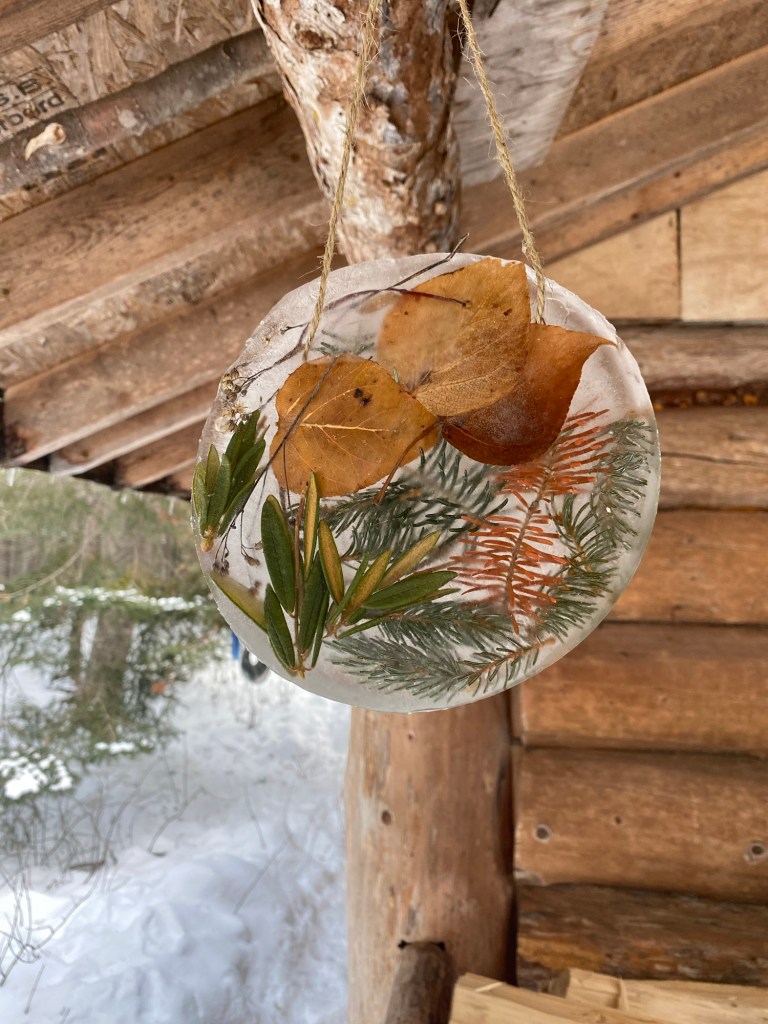
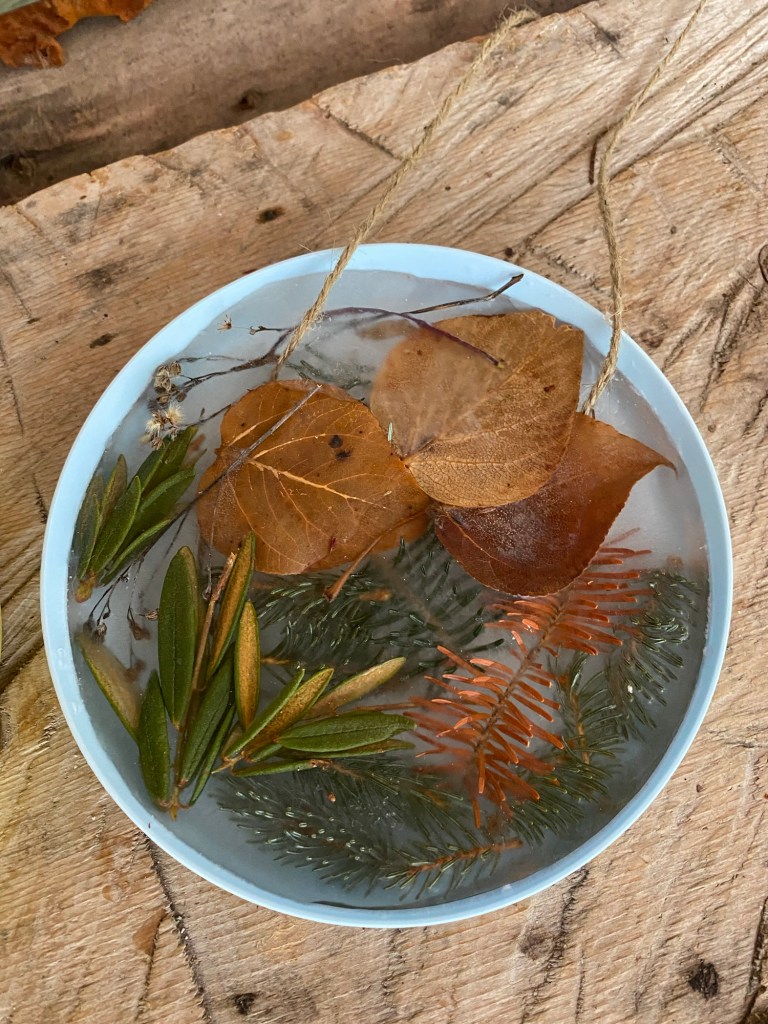
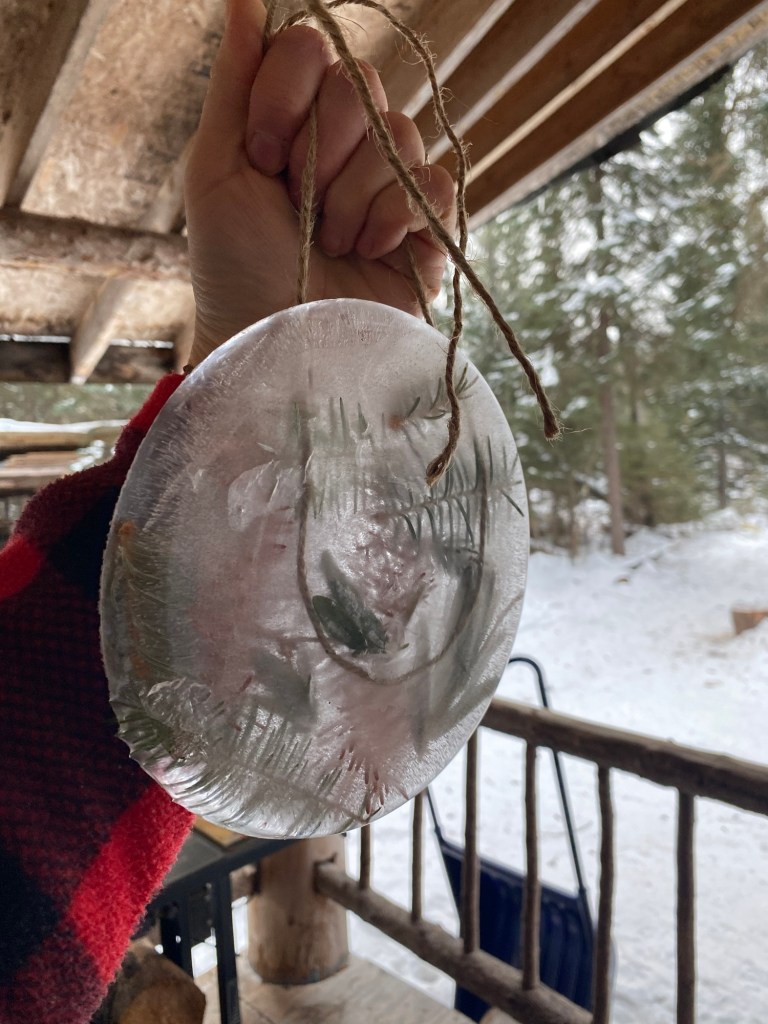
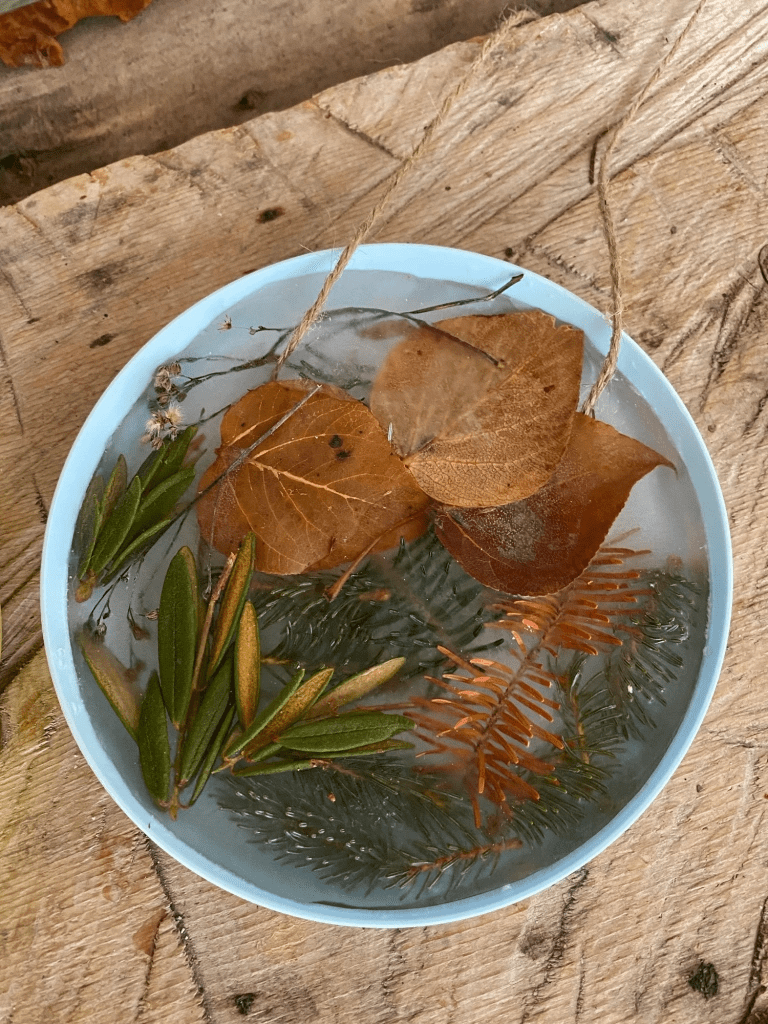
    One of the previous families to visit the cabin had hung up some coloured ice sun-catchers (see pictures below), using food colouring or paints, and hung up outside the windows. We loved to look at these while cooking in the kitchen or eating our meals!

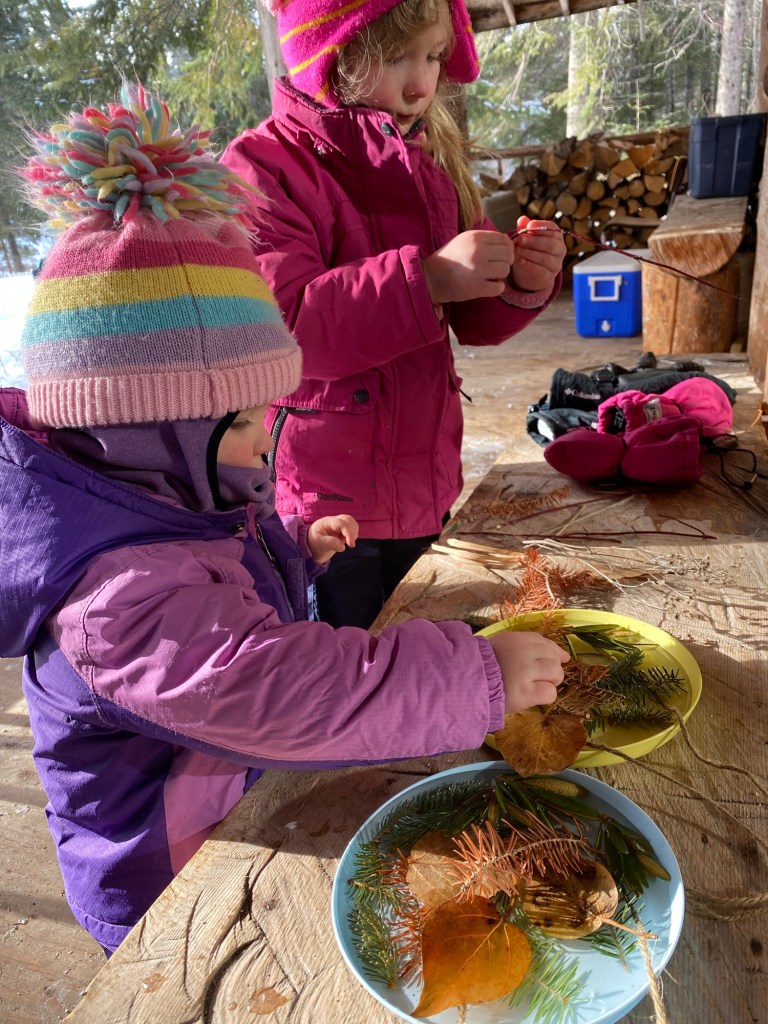
    We were inspired to also make something similar, but we didn’t have anything to colour the water/ice with. We decided to do some exploring around the cabin and find natural items to use instead.

    This was a wonderful activity and natural inquiry for our oldest, as she scavenged for different sticks, leaves, dried flowers, pine and spruce needles.

    “What’s this Mommy?” pointing to a stick covered in a black fungus, “It looks like something pooped on it!”

    Or “discovering” what a raspberry bush looks like/feels like in winter without the leaves on it (thorns!).
    I love that we used natural items to do this activity, so that as it melts in the spring, the decorations frozen in the ice will decompose over time on the ground. We also used natural twine to hang it up that we found hanging around from previous visitors.

    Enjoy! Send Northbird pictures of your Ice Sun-catcher creations, we’d love to see them!

    A brief video of when our girls made Ice Sun-catchers.

    How to Make Ice Sun-Catchers

    Supplies Needed:

    • Warm water (the warmth helps so the kid’s fingers don’t get too cold during the activity if you are assembling the plate outside)
    • String
    • Scissors
    • Plastic plate or paper plate with a rim
    • Outdoor nature decorations (leaves, sticks, dried flowers, bark, etc)

    Directions:

    1. Explore your backyard for various items to decorate your Ice Sun-catcher with. (See ideas above)

    2. Lay the plate down on a flat surface. If you are assembling the plate inside, you might want to first put the plate on a cookie sheet. Fill the plate with water.

    3. Cut string to desired length for hanging up. (I recommend a minimum of 3 feet). Place the string in a “U” shape, with the untied ends hanging out, pushing the string into the water.
    4. Lay your selected nature decorations on the plate, pushing them gently into the water.

    5. Leave plate outside overnight or until completely frozen.

    6. Carefully transfer out of plate. If it is a paper plate, the plate can be easily cut off.

    7. Hang up outside where it can be viewed and enjoyed!

    Hi, I’m Jessie!

    I’m a Wife and Homeschooling Mom living in a remote town in Northern Ontario, Canada. I love making wholesome meals for my family from scratch, homeschooling our girls and learning more about natural living.

    Read more about my story HERE.

    Subscribe to Northbird’s email list to get weekly posts on: tasty recipes, activity ideas for kids, natural living tips, and some genuine mom thoughts and encouragement!

    How to Make an Ice Sun-Catcher

    • Difficulty: Easy
    • Print

    This is a fun winter activity to do with your kids! Combine it with exploring your backyard or local park for natural decorations to freeze in it!

    Supplies Needed:

  • Warm water (the warmth helps so the kid’s fingers don’t get too cold during the activity if you are assembling the plate outside)
  • String
  • Scissors
  • Plastic plate or paper plate with a rim
  • Outdoor nature decorations (leaves, sticks, dried flowers, bark, etc)
  • Directions:

    1. Explore your backyard for various items to decorate your Ice Sun-catcher with. (See ideas above)
    2. Lay the plate down on a flat surface. If you are assembling the plate inside, you might want to first put the plate on a cookie sheet. Fill the plate with water.
    3. Cut string to desired length for hanging up. (I recommend a minimum of 3 feet). Place the string in a “U” shape, with the untied ends hanging out, pushing the string into the water.
    4. Lay your selected nature decorations on the plate, pushing them gently into the water.
    5. Leave plate outside overnight or until completely frozen.
    6. Carefully transfer out of plate. If it is paper, the plate can be easily cut off.
    7. Hang up outside where it can be viewed and enjoyed!

    Return to Top

    Homemade Valentine Balloon Cards: Creative Homeschooling Activity for Kids

    Find Northbird on social media:

    This post contains affiliate links. As an Amazon associate, I earn from qualifying purchases. This means that I make a small commission at no extra cost to you. You can read my full disclosure HERE.

    Jump to Printable Activity Card

    Return to “Homeschooling Activities and Resources”

    I love celebrating Valentines Day, and using this opportunity to speak words of encouragement and love into my little girls and husband.

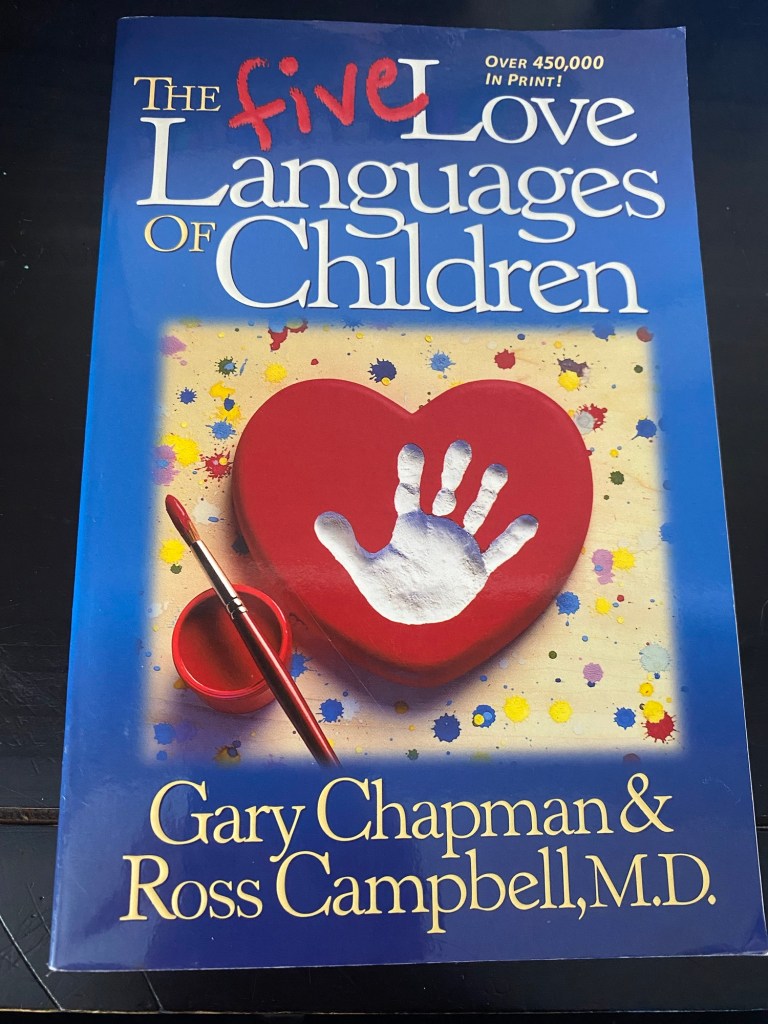
    I recently started reading “The Five Love Languages of Children” by Gary Chapman & Ross Campbell, M.D., and it is just as good as the Love Languages book that was written for adults.

    Every child needs to know that they are loved and valued, and this book focuses on learning how to express that love in a way that your child can understand it in their own unique way. I highly recommend this book as a parenting resource to check out!

    To summarize the Five Love Languages, these are the common ways that each person receives and gives love:

    • Quality Time
    • Words of Affirmation
    • Gifts
    • Acts of Service
    • Physical Touch

    “We believe a child’s need for love is basic to all other needs. Receiving love and learning to give love is the soil out of which all positive human endeavors grow.” -Gary Chapman & Ross Campbell

    Other Love Language books that I love from Gary Chapman:

    Applying this to our Home:

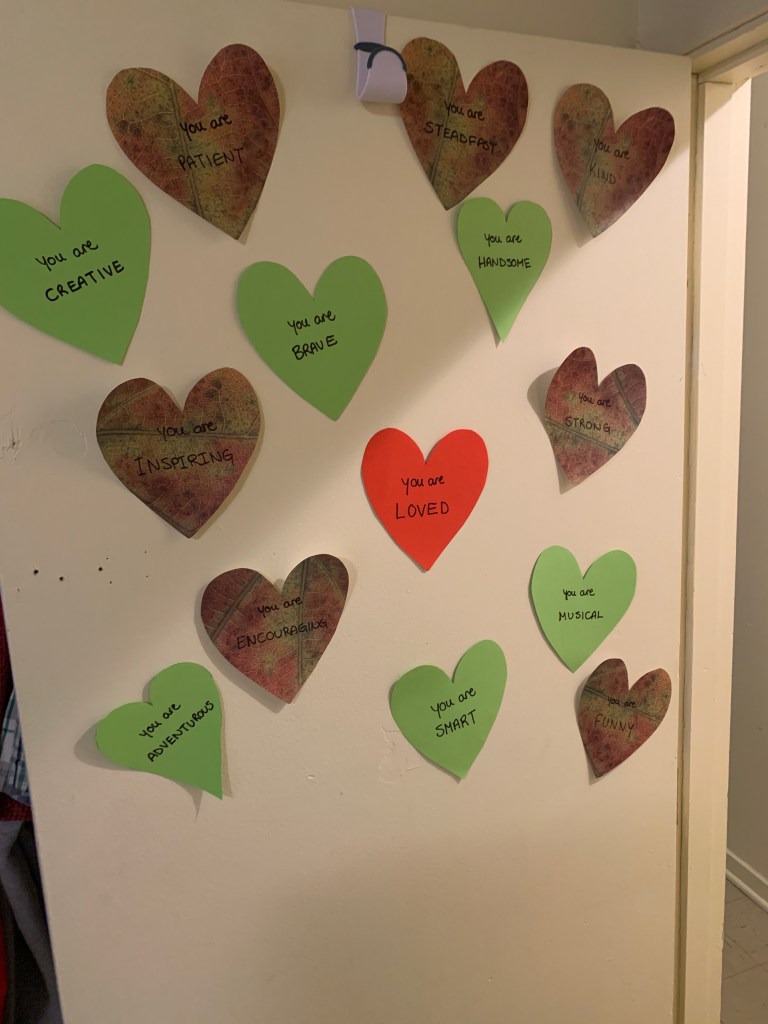
    Since my oldest was about 18 months, I have kept up this tradition for her and my husband as a way of speaking and affirming words of encouragement for them:

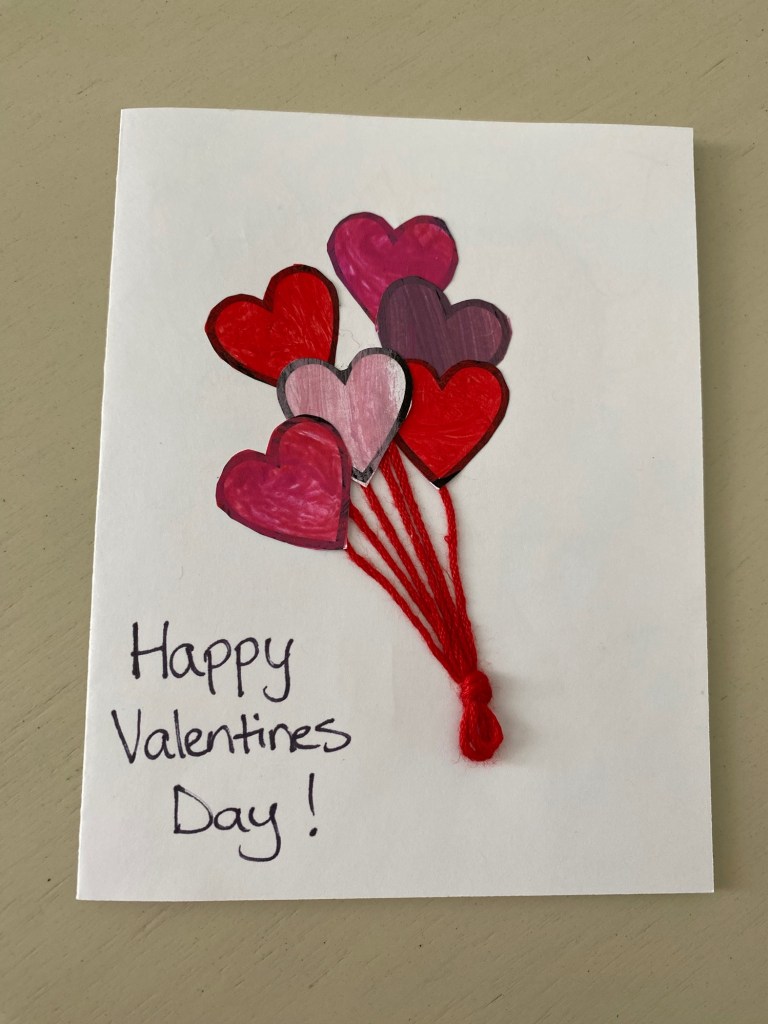
    Every day, for the 14 days leading up to Valentines day, I put a heart on their doors with a word that I feel describes part of who they are. I always end on the 14th day with a red heart saying: “You Are Loved”.

    This particular year, we joined an online Homeschooling Valentine exchange group on facebook to make and sends cards to other homeschooling students all over Canada. The idea was to incorporate a little geography learning of our country for my 5-year-old, and also understanding more about the postal system.

    The result: my particular online group had 30+ students that we needed to make cards for! (Honestly, a little mind boggling in addition to the other valentine cards for family and friends that we were ALREADY going to make!)

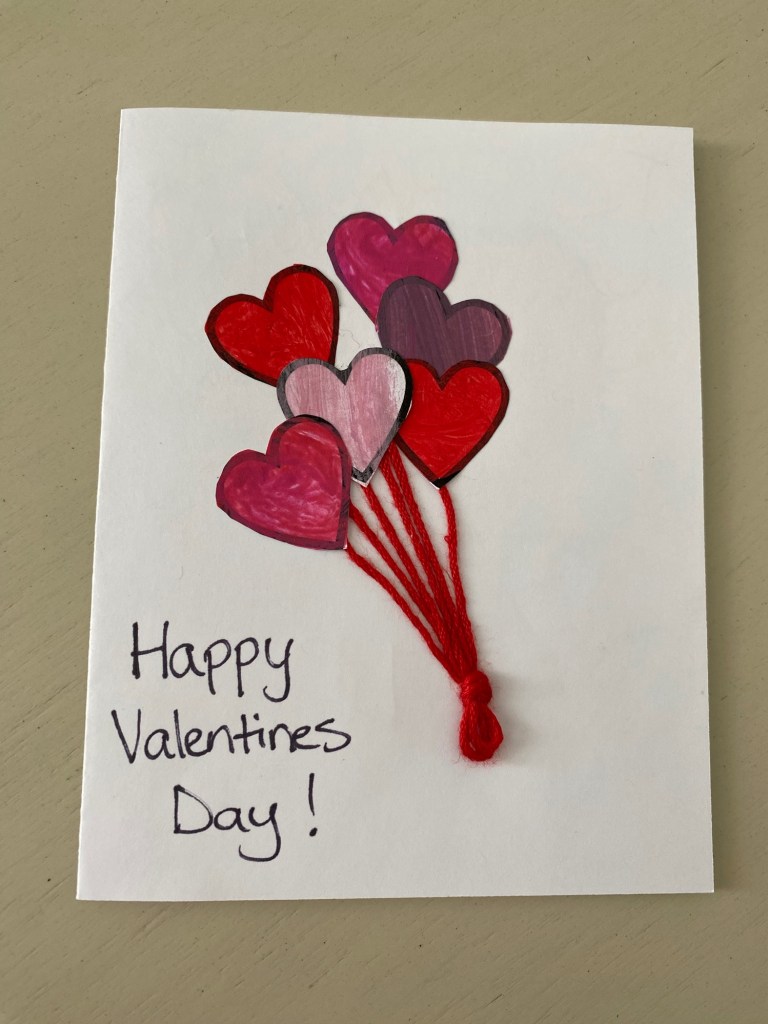
    So the girls and I decided to create something that would be relatively simple, yet creative, customizable, and could easily be in a flat envelope (not a bulky card, and less expensive to post).

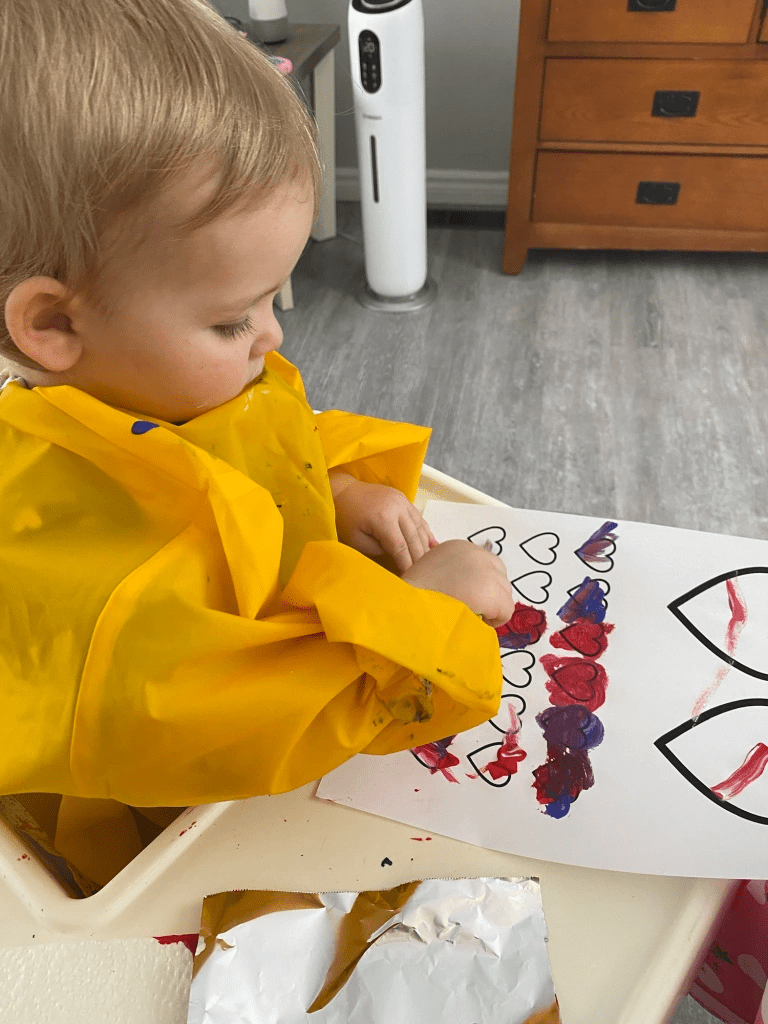
    I also wanted to make something that my youngest (not yet 2) could participate in (and for it to look somewhat still pleasing to the eye!).

    I have included here the free template that the girls and I used to paint and cut out for the cards, as you’ll see more in the directions below on how to use this template.

    I hope your kids have fun with this creative activity as much as mine did!

    How to Make Valentine Balloon Cards:

    Supplies Needed:

    Directions:

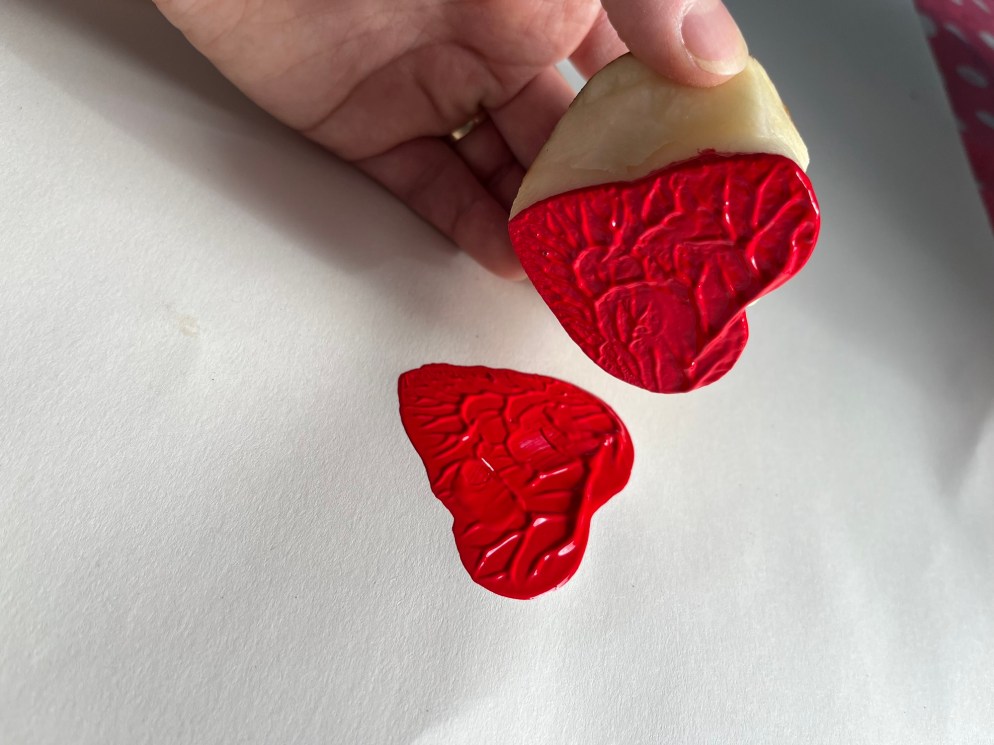
    1. Print and paint on heart template.

    2. When paint has dried, cut out painted hearts.

    3. Cut 1 page of card stock paper in half for two cards, and pre-cut string for balloon hearts and bow.

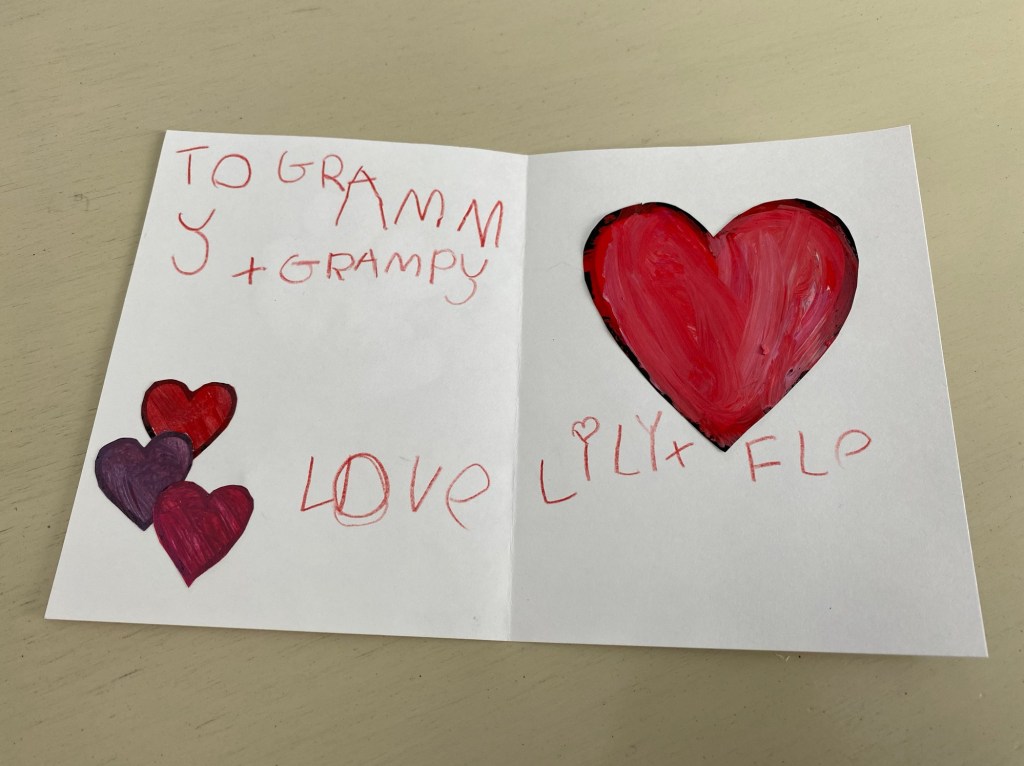
    4. Tie string at one end with ends amounting to number of “balloons” you wish to use on the front of card. Glue all and write on front of card if desired.

    5. Glue remaining hearts on the inside of card and write/decorate as desired.

    6. Enclose with one of these simple white envelopes that fit perfectly!

    Additional Notes: This activity could be easily done with inserting coloured paper into your printer and then print the template form to eliminate the painting step.

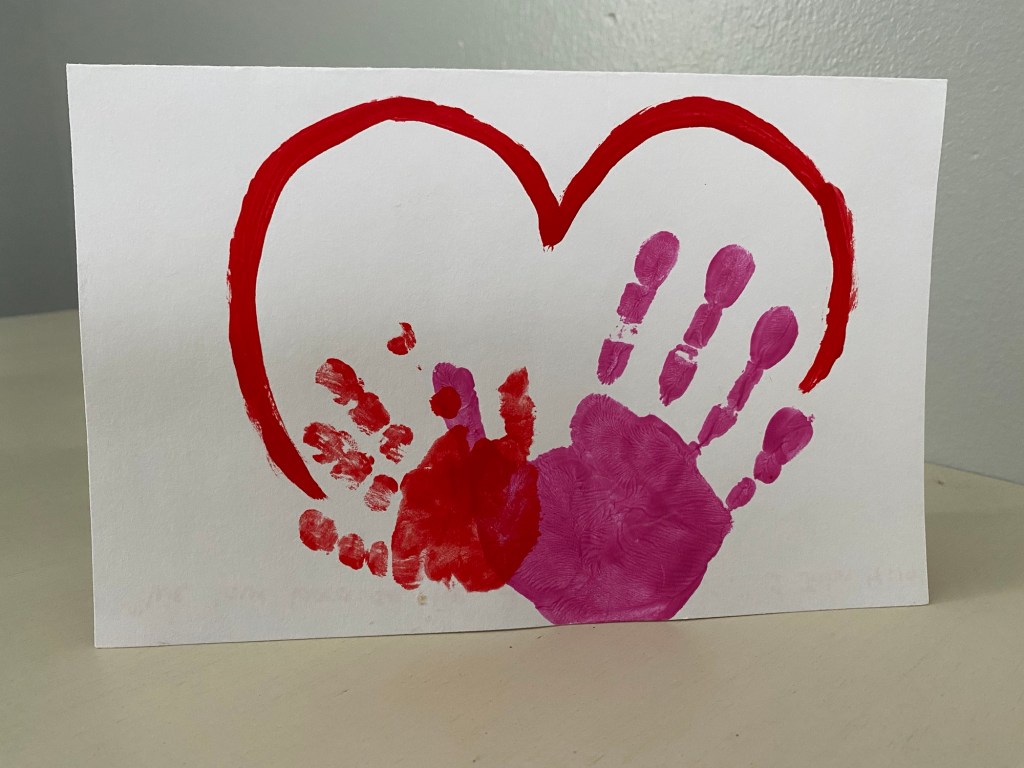
    Here are other homemade Valentine Cards we have done in the past:

    Hi, I’m Jessie!

    I’m a Wife and Homeschooling Mom living in a remote town in Northern Ontario, Canada. I love making wholesome meals for my family from scratch, homeschooling our girls and learning more about natural living.

    Read more about my story HERE.

    Subscribe to Northbird’s email list to get weekly posts on: tasty recipes, activity ideas for kids, natural living tips, and some genuine mom thoughts and encouragement!

    Homemade Valentine Balloon Cards

    • Difficulty: Easy
    • Print

    A sweet little homemade valentine card that the girls and I designed. Directions and a free template included!


    This activity could be easily done with inserting coloured paper into your printer and then print the template form to eliminate the painting step.


    Directions:

    1. Print and paint on heart template.
    2. When paint has dried, cut out painted hearts.
    3. Cut 1 page of card stock paper in half for two cards, and pre-cut string for balloon hearts and bow.
    4. Tie string at one end with ends amounting to number of “balloons” you wish to use on the front of card. Glue all and write on front of card if desired.
    5. Glue remaining hearts on the inside of card and write/decorate as desired.

    Return to Top

    Easy Pipe Cleaner Christmas Ornament

    Find Northbird on social media:

    This post contains affiliate links. As an Amazon associate, I earn from qualifying purchases. This means that I make a small commission at no extra cost to you. You can read my full disclosure HERE.

    Return to Christmas Activities

    Jump to Printable Craft Directions

    It’s FINALLY December?!

    Up here in Northern Ontario we’ve had snow for several weeks now and our local Moose River has finally begun to freeze over. But it’s honestly felt like this year had the longest November that I can remember, and December seemed to take forever to come!

    Our friendly neighbourhood has now started hanging up Christmas decorations, and the local schools have begun hosting Christmas bazaars every weekend leading up to the holidays.

    The kids are getting so excited for Christmas (especially our oldest), not only with decorating our home and having lots of community parties, but also the chance to hop on the train south to visit our families.

    Every year I have tried to organize an ornament craft for our oldest to make and give to her Daddy, grandparents, and other relations and friends. This always gives her a sense of pride and accomplishment to see something that she has made and worked hard on to end up on our relation’s Christmas trees, and hung on garland throughout our family’s living room.

    Usually I look for ideas on Pinterest or Google that are somewhat flat and could travel well by mail, as many of our relatives live far away from us and we are not able to see everyone in the short time we travel south at Christmas.

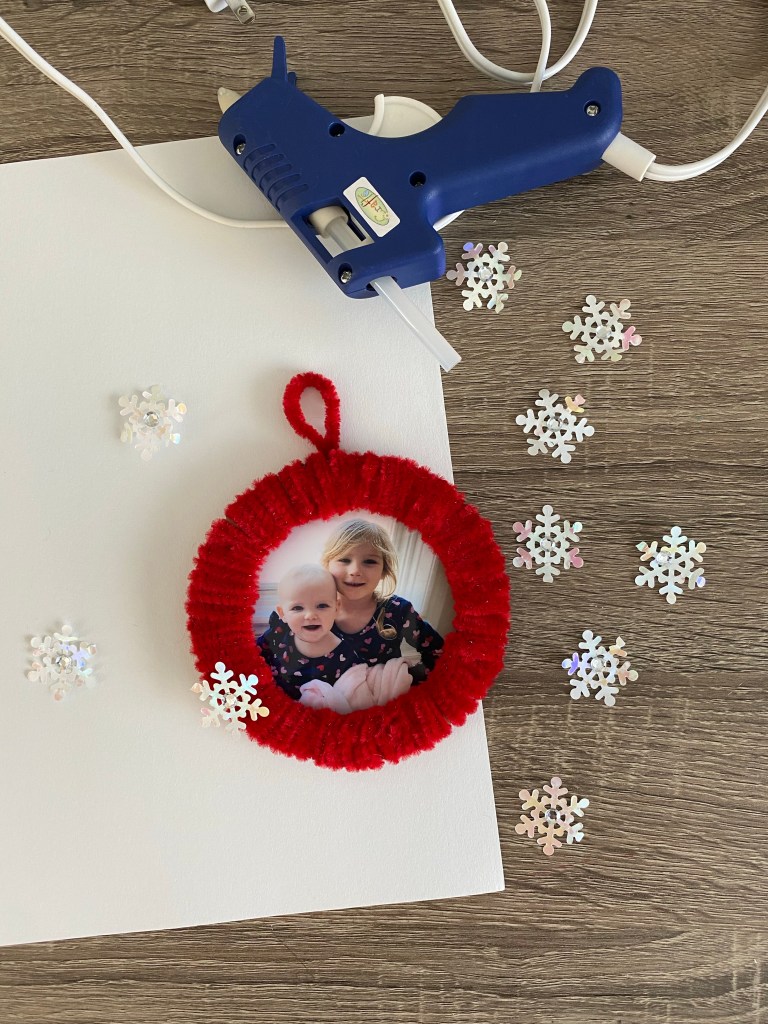
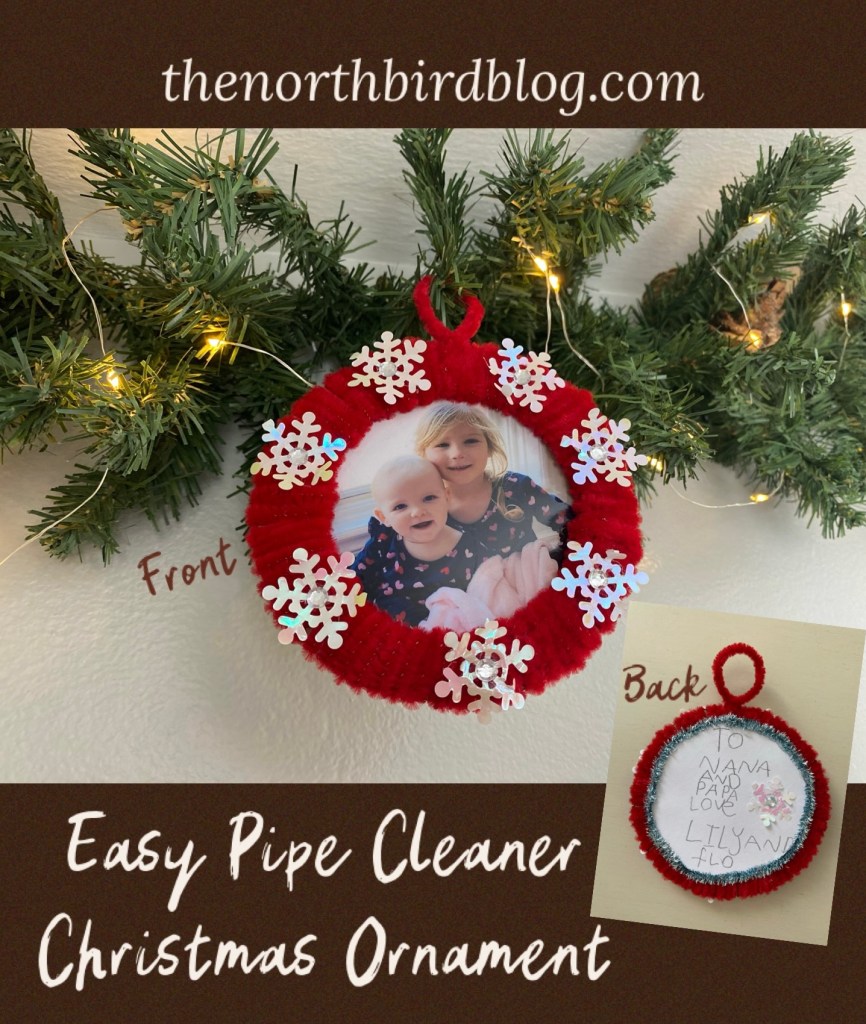
    The other day I looked around the house at what we had to work with and ended up creating this easy and customizable picture ornament with my oldest daughter.

    I hope this simple gift idea inspires you and your kids with fun and joy this season!

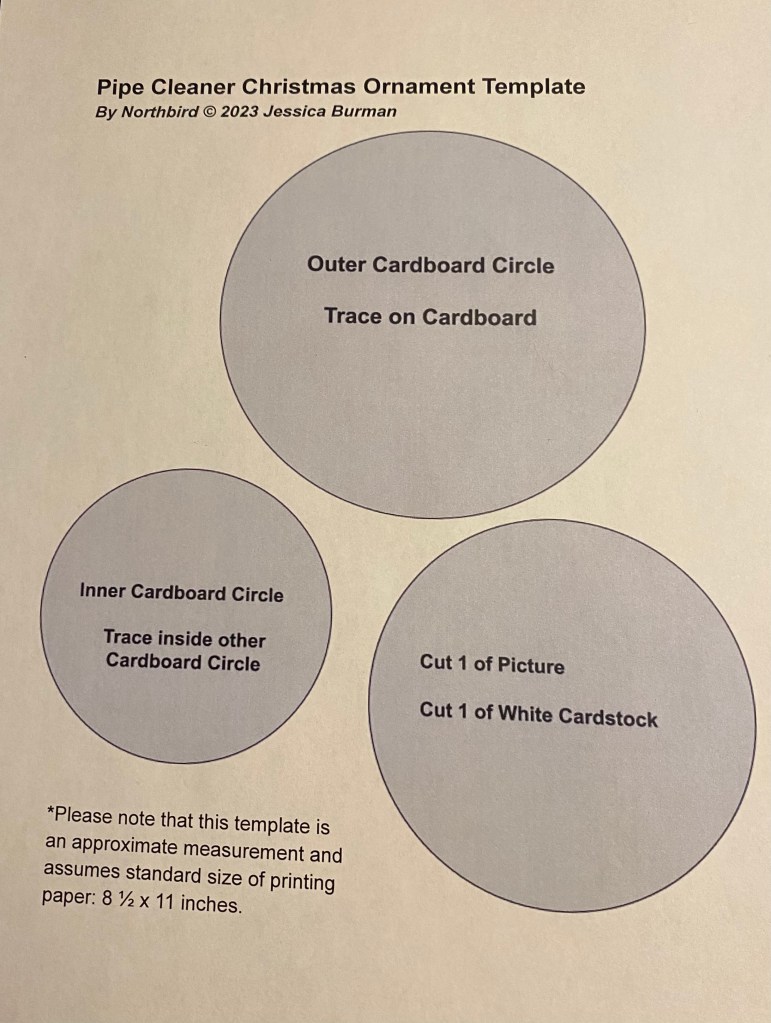
    You can download the FREE pre-measured circle template HERE.

    How to make this Easy Pipe Cleaner Christmas Ornament:

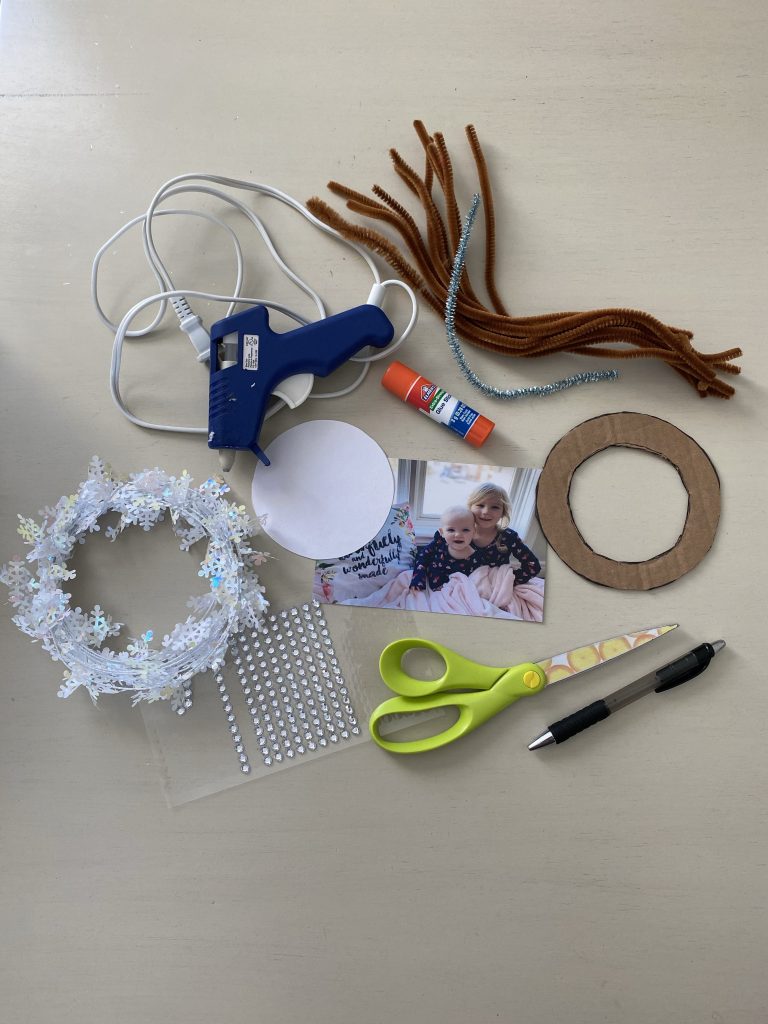
    Supplies Needed:

    • Hot glue gun
    • Glue stick
    • Pen or marker
    • Scissors
    • Pipe cleaners (10-15, depending on how long they are and how thick you wrap the cardboard)
    • Cardboard
    • Print the free template to trace the circles HERE
    • Round plastic containers to trace, different sizes (If you aren’t able to print the template)
    • Picture
    • White card stock paper
    • Items to decorate with (glue or stick on)

    Directions:

    1. Trace cardboard circles, using two different sizes of round cups or plastic containers. The outer circle is approximately 5 inches (12.5cm) in diameter, and the inner one is 3 inches (8cm) in diameter. Disregard this if you are able to print the template, and simply follow the template directions.

    2. Cut out the centre of the cardboard circle.

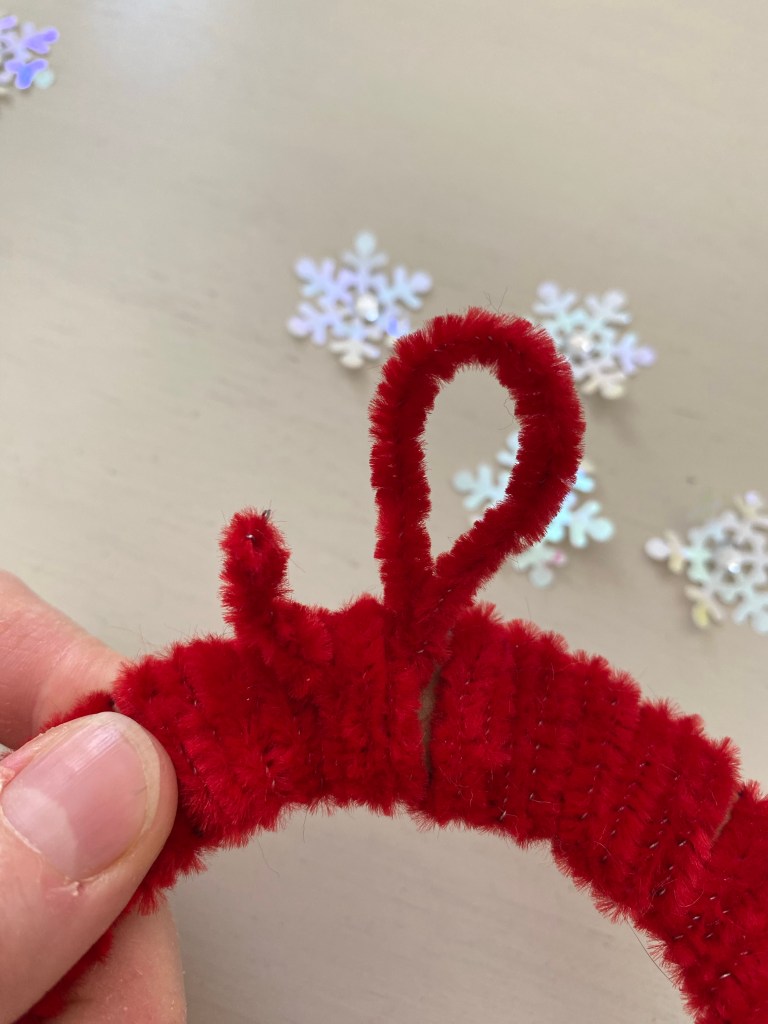
    3. Begin wrapping the pipe cleaners around the cardboard frame, tucking in the end pieces when you start a new pipe cleaner. Tuck the final piece in.

    4. Make a loop out of a pipe cleaner and attach and tuck it through a few strands, twisting it so it doesn’t come undone.

    5. Trace around another round plastic container and cut out circles of your chosen picture and a piece of white card-stock paper. I used a circle size that was middle in size comparison to the other two circles, approximately 3 1/2 inches (9 cm) in diameter. The free printable template includes this too.

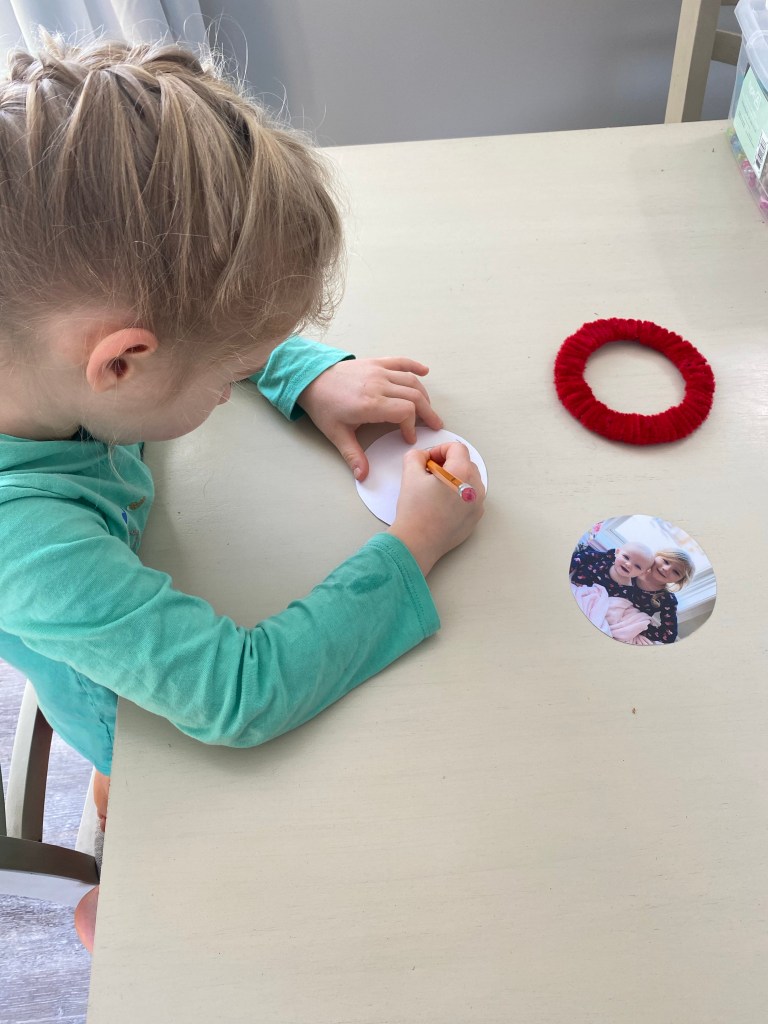
    6. Write a personal message if desired, or instead cut out another picture to insert, so that there is a picture to see on both sides of your ornament.

    7. Use your glue stick to glue the backs of the two circles together.

    8. Take your hot glue gun (I recommend that adults handle this part!), and put glue around the edge of the picture front, then place the pipe cleaner frame on top of the picture and hold in place firmly while the glue dries (its fast!)

    9. Add any desired decorations to the front and back. For this, we hot glued jewelled snowflakes to both sides and also glued a sparkly pipe cleaner to the back ring to hide the paper edge.

    10. Enjoy! I’d love to hear from you and see how yours turned out!

    Download and print the Free Circle Templates HERE.

    Hi, I’m Jessie!

    I’m a Wife and Homeschooling Mom living in a remote town in Northern Ontario, Canada. I love making wholesome meals for my family from scratch, homeschooling our girls and learning more about natural living.

    Read more about my story HERE.

    Subscribe to Northbird’s email list to get weekly posts on: tasty recipes, activity ideas for kids, natural living tips, and some genuine mom thoughts and encouragement!

    Pipe Cleaner Christmas Ornament

    • Servings: 1 Ornament
    • Difficulty: Easy
    • Print

    Here's an Easy Christmas Ornament Craft to do with your child this season!

    Supplies Needed:

  • Hot glue gun
  • Glue stick
  • Pen or marker
  • Scissors
  • Pipe cleaners (10-15, depending on how long they are and how thick you wrap the cardboard)
  • Cardboard
  • Print the free template to trace the circles HERE
  • Round plastic containers to trace, different sizes (If you aren’t able to print the template)
  • Picture
  • White card stock paper
  • Items to decorate with (glue or stick on)

  • Directions:

    1. Trace cardboard circles, using two different sizes of round cups or plastic containers. The outer circle is approximately 5 inches (12.5cm) in diameter, and the inner one is 3 inches (8cm) in diameter. Disregard this if you are able to print the template, and simply follow the template directions.
    2. Cut out the centre of the cardboard circle.
    3. Begin wrapping the pipe cleaners around the cardboard frame, tucking in the end pieces when you start a new pipe cleaner. Tuck the final piece in.
    4. Make a loop out of a pipe cleaner and attach and tuck it through a few strands, twisting it so it doesn’t come undone.
    5. Trace around another round plastic container and cut out circles of your chosen picture and a piece of white card-stock paper. I used a circle size that was middle in size comparison to the other two circles, approximately 3 1/2 inches (9 cm) in diameter. The free printable template includes this too.
    6. Write a personal message if desired, or instead cut out another picture to insert, so that there is a picture to see on both sides of your ornament.
    7. Use your glue stick to glue the backs of the two circles together.
    8. Take your hot glue gun (I recommend that adults handle this part!), and put glue around the edge of the picture front, then place the pipe cleaner frame on top of the picture and hold in place firmly while the glue dries (its fast!)
    9. Add any desired decorations to the front and back. For this, we hot glued jewelled snowflakes to both sides and also glued a sparkly pipe cleaner to the back ring to hide the paper edge.
    10. Enjoy! I’d love to hear from you and see how yours turned out!

    Return to Top