Make Mini Ocean Zones in a Jar! An Experiment on Liquid Viscosity

Find Northbird on social media:

Return to “Homeschooling Activities & Resources”

Return to “Ocean Life”

Jump to Printable Activity Card

What is Liquid Viscosity?

Viscosity is the measurement of a liquid’s strength of resistance to flow. For example, a liquid with high viscosity will be thicker and generally be move slower if you were to pour it out. Liquids with low viscosity will be thinner, and flow quickly if you were to pour it out.

Examples of Liquids with a High Viscosity:

  • Honey
  • Molasses
  • Corn Syrup
  • Chocolate Syrup

Examples of Liquids with a Low Viscosity:

  • Water
  • Rubbing Alcohol
  • Milk
  • Fruit Juices

Experiment: Make Your Own Ocean Zones in a Jar!

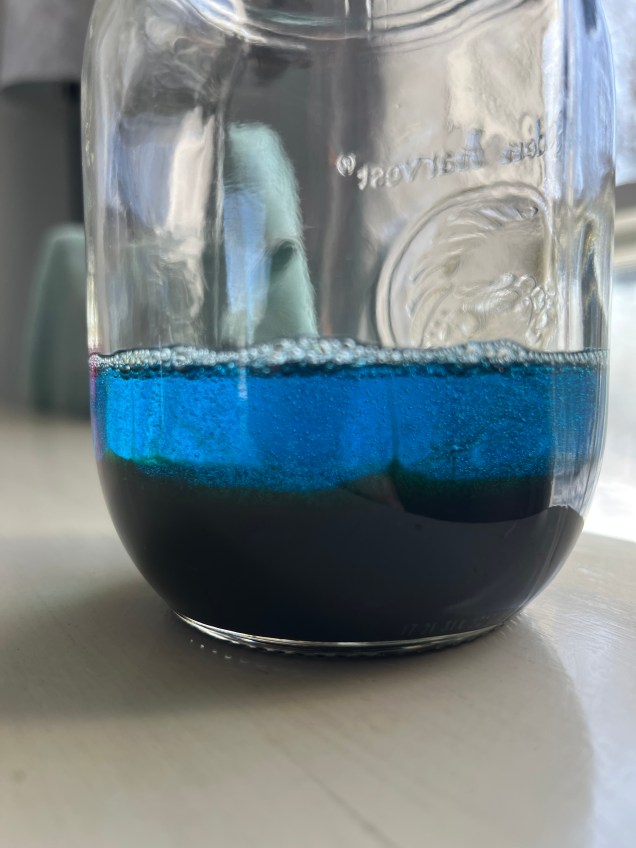
This is a great visual and hands-on illustration of the Ocean Layers, and also a great way for students to learn about liquid viscosity!

Supplies Needed:

Liquids Needed:

Use equal amounts of the different liquids each time, but the amount might be different based on what size jar you have available:

  • For a 1 litre jar (almost a quart), you will measure out approximately 2/3 cup each liquid.
  • For a 500ml jar (almost a pint) you will measure out approximately 1/3 cup each liquid.
Directions:

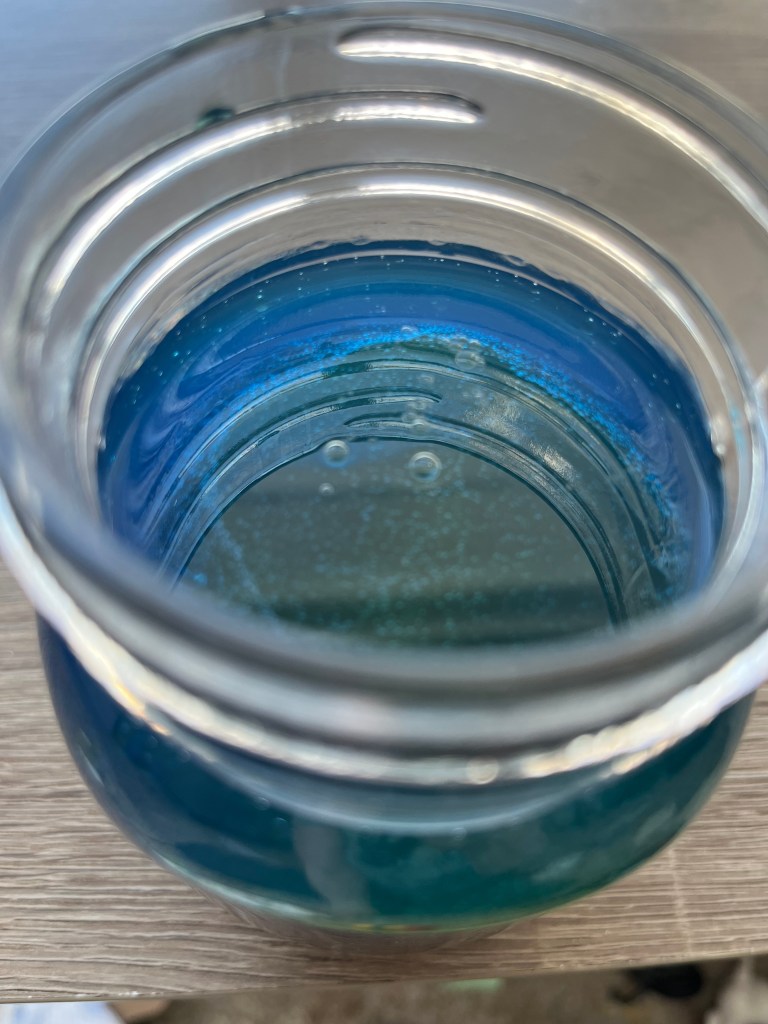
  1. Measure out the bottom liquid first. If using Molasses, simply add into the bottom. If using corn syrup then first add red, green and blue drops of food colouring until it is black. Pour into bottom of jar. This is “The Trench”.
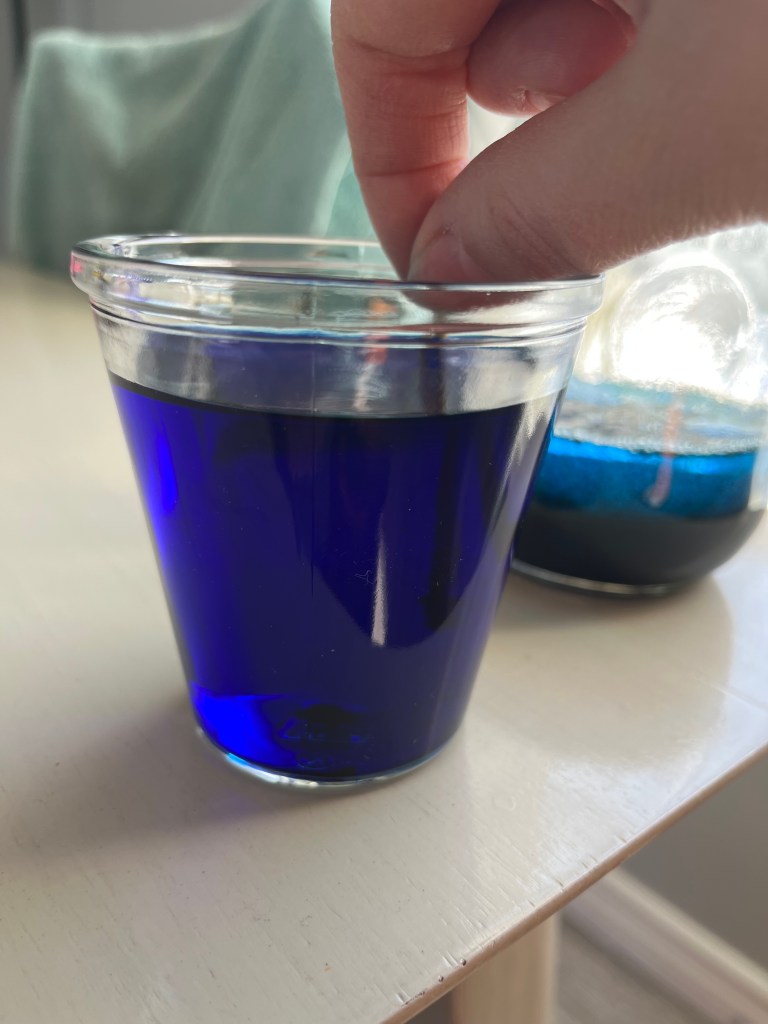
  2. Measure out dish soap and use a funnel to slowly pour into the jar on top of the corn syrup/molasses. This is “The Abyss”. If using a clear dishsoap, add colouring to make a dark blue or purple colour.
  3. Measure out water and add some colouring drops to make a deep blue/purple colour (different shade from the layer below it. Pour through the funnel slowly to add to the layers. This is now the “Bathypelagic”, or “Midnight Zone”.
  4. Measure out the vegetable oil and add through the funnel. You can try to use food colouring, but it is not likely to mix and change colour (We tried! And most people don’t do it in their videos anyway). This is now the “Mesopelagic”, or “Twilight Zone”.
  5. Measure out the rubbing alcohol and add to the top (very carefully!) to make the “Epipelagic”, or “Sunlight Zone”.
Additional Notes:

  • Take your time when pouring the liquid layers on top of each other. If you pour too quickly then the layers will mix and you may have to wait while they settle themselves out.
  • Use a funnel only for the first few layers. Keep an eye that the funnel is not inserted too deep when you are pouring layers or the liquids will mix. If you have a few hands helping with this activity, then one student could hold the funnel up so that it is not touching the liquids. Or consider using a small spoon for the last few layers to carefully add the top liquids.
  • Based on your available liquid ingredients on hand, adjust your food colouring so that you will be able to distinguish the different layers. For example, we used blue dawn dish soap for the abyss layer so we just made the water layer above it have more purple. But if you are using a clear dish soap, you might want to make the abyss layer have dark purple, and then make the water layer above it be a deep blue.

For those that like more visual illustrations, here is an excellent example of this experiment with similar ingredients and measurements, done by Mote Marine Laboratory & Aquarium.

More About The Ocean Layers (Pelagic Zones)

What are the “Pelagic Zones”?

The pelagic zones, or layers of the oceans are split up into 6 areas, ranging from the most shallow intertidal zone near the sunny surface, to the deepest and darkest depths of the hadalpelagic trenches.

The Intertidal Zone:

This area is the closest to the surface of the ocean, and is determined by the fluctuating ocean levels of high and low tide. It also contains tide pools that have their own unique ecosystem and are home to many different animals and plants.

Animals that live in this zone have to be able to adapt to both water and land, with the constantly changing high and low tides. These commonly include: small crabs, starfish, sea urchins, barnacles and anemones. Many other marine animals such as walruses and seals also live at the ocean’s edge so they can hunt for nearby food in the surface layers.

This is a great video of life in the Intertidal Zone:

The Epipelagic (Sunlight Zone):

The Epipelagic is considered the busiest and brightest area of the ocean. You could think of it like the “Epi-center” of the ocean, as it is estimated that around 90% of ocean animals, plants and different organisms live in this pelagic zone.

This zone travels down approximately 198 meters below the surface of the ocean, and temperature ranges from -2 to 36 degrees celcius, depending on warm or colder climate areas.

Due to the abundance of sunlight in this zone, underwater plant life is able to go through photosynthesis, which in turn produces oxygen for the marine animals that live there.

Check out this video on the Epipelagic Zone:

The Mesopelagic (Twilight Zone):

As one travels deeper into the ocean, you will come to the mesopelagic layer, or twilight zone. Here the amount of sunlight piercing through is less, which decreases the visibility at this depth of the ocean. As a result, there is typically less vegetation growing.

This zone is approximately 198 meters to 1,000 meters below sea level, and temperature ranges from -4 to 21 degrees celcius.

Animals that are commonly found in this zone are: blobfish, large crabs, sperm whales, swordfish, some eels, giant squid, and cuttlefish. Many of these animals also travel up and down through the layers as they seasonally migrate or hunt for food.

Check out this video on life in the Mesopelagic Layer:

The Bathypelagic (Midnight Zone):

Life in the Midnight Zone is quite dark, as there is almost no light that reaches to this depth. And yet there is still quite a lot of life!

The animals that live down at this level often have large eyes to help see whatever light there may be, and many of them are bioluminescent. (This means that they can omit their own form of light in their bodies!)

A few of these interesting animals include the vampire squid, various crustaceans, anglerfish, dragonfish, gulper eels, viperfish, and the lanternfish.

This zone is approximately 1,000 meters to 4,000 meters below sea level, and temperature stays near -4 degrees celcius.

Bruce Robinson from the Monterey Bay Aquarium shares a little of his work exploring the marine life of the Midnight Zone in this short video:

The Abyssopelagic (The Abyss):

Very near the ocean floor is the area known as the abyss. The depth here extends from approximately 4,000 meters to 6,100 meters deep! The cold water temperature stays around 1.7 degrees celcius.

Even though it is a harsh environment, many animals can still thrive in this cold and dark part of the ocean. Many of them are bioluminescent and eat dead creatures and plant life that fall down from the layers above. Some of these include the dumbo octopus, some eels, sea pigs, tripod fish, and sea spiders.

This video shows some fascinating animals found through the lower layers of the deep ocean!

The Hadalpelagic (The Trench):

And finally THE BOTTOM. At approximately 6,100 meters is the general area known as “the trench”, which is made up of caves and crevices that open up the ocean floor all over the earth. The Mariana Trench is the deepest recorded place in the ocean, with depth measuring at around 10, 984 meters.

There is extreme pressure at this depth, which makes it hard for any marine life to survive! But scientists have found a few species that live near hydrothermal vents in the ocean floor, such as giant tubeworms, hadal snailfish, and various amphipods. Cusk eels are the deepest recorded fish to be found at 8,370 meters.

The temperature tends to hover around 4 degrees celcius in the hadalpelagic zone.

Made this Mini Ocean Zone Activity?

I’d LOVE to see your results!! Feel free to post to your social media account and tag Northbird using one of the links below or post in the comments!

Hi, I’m Jessie!

I’m a Wife and Homeschooling Mom living in a remote town in Northern Ontario, Canada. I love making wholesome meals for my family from scratch, homeschooling our girls and learning more about natural living.

Read more about my story HERE.

Subscribe to Northbird’s email list to get weekly posts on: tasty recipes, activity ideas for kids, natural living tips, and some genuine mom thoughts and encouragement!


Make Mini Ocean Zones in a Jar

A fun experiment illustrating the Zones of the Ocean, and learning about liquid Viscosity.


The Northbird Blog http://www.thenorthbirdblog.com


Liquids Needed

  • Rubbing alcohol (Sunlight Zone)
  • Vegetable Oil (Twilight Zone)
  • Water (Midnight Zone)
  • Dish Soap, blue coloured-type is best like Dawn (The Abyss)
  • Corn syrup or Molasses (The Trench)

  • Directions

    1. Measure out the bottom liquid first. If using Molasses, simply add into the bottom. If using corn syrup then first add red, green and blue drops of food colouring until it is black. Pour into bottom of jar. This is “The Trench”.
    2. Measure out dish soap and use a funnel to slowly pour into the jar on top of the corn syrup/molasses. This is “The Abyss”. If using a clear dishsoap, add colouring to make a dark blue or purple colour.
    3. Measure out water and add some colouring drops to make a deep blue/purple colour (different shade from the layer below it. Pour through the funnel slowly to add to the layers. This is now the “Bathypelagic”, or “Midnight Zone”.
    4. Measure out the vegetable oil and add through the funnel. You can try to use food colouring, but it is not likely to mix and change colour (We tried! And most people don’t do it in their videos anyway). This is now the “Mesopelagic”, or “Twilight Zone”.
    5. Measure out the rubbing alcohol and add to the top (very carefully!) to make the “Epipelagic”, or “Sunlight Zone”.

    Additional Notes:

    • Take your time when pouring the liquid layers on top of each other. If you pour too quickly then the layers will mix and you may have to wait while they settle themselves out.
    • Use a funnel only for the first few layers. Keep an eye that the funnel is not inserted too deep when you are pouring layers or the liquids will mix. If you have a few hands helping with this activity, then one student could hold the funnel up so that it is not touching the liquids. Or consider using a small spoon for the last few layers to carefully add the top liquids.
    • Based on your available liquid ingredients on hand, adjust your food colouring so that you will be able to distinguish the different layers. For example, we used blue dawn dish soap for the abyss layer so we just made the water layer above it have more purple. But if you are using a clear dish soap, you might want to make the abyss layer have dark purple, and then make the water layer above it be a deep blue.
    • Use equal amounts of the different liquids each time, but the amount might be different based on what size jar you have available:
    • – For a 1 litre jar (almost a quart), you will measure out approximately 2/3 cup each liquid.

      – For a 500ml jar (almost a pint) you will measure out approximately 1/3 cup each liquid.

    Return to Top

    This post contains affiliate links. As an Amazon associate, I earn from qualifying purchases. This means that I make a small commission at no extra cost to you. You can read my full disclosure HERE.

    Ocean Pelagic Zone Booklet: A Fun Learning Resource for Students

    Find Northbird on social media:

    Return to “Homeschooling Activities & Resources”

    Return to “Ocean Life”

    Designing This Mini Pelagic Zone Booklet:

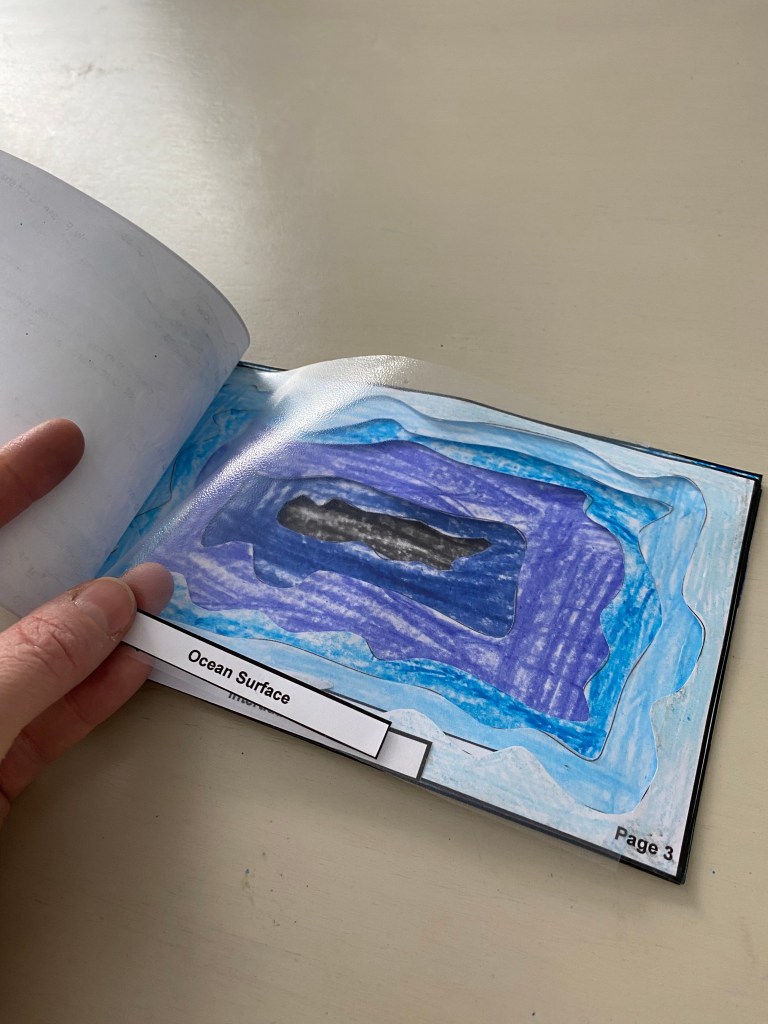
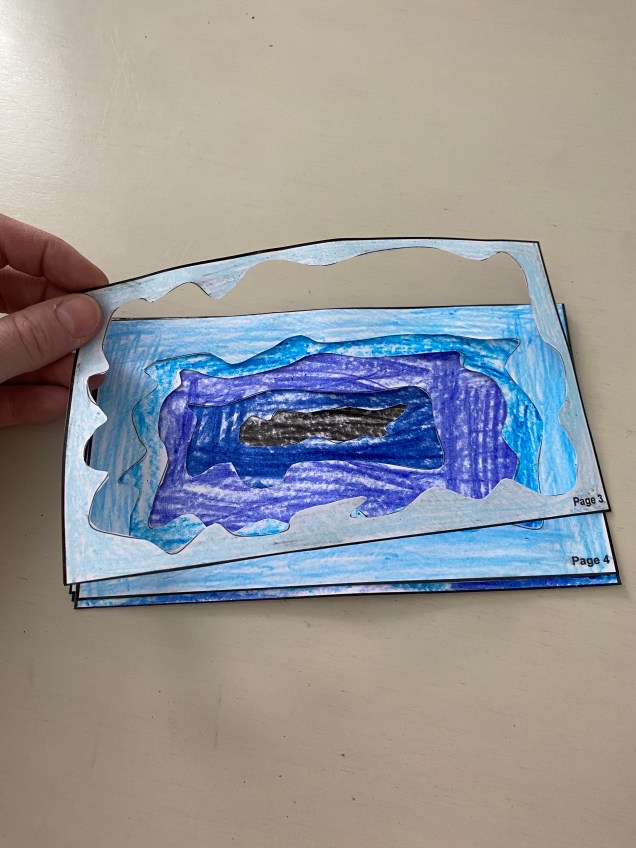
    This project was fun to create! I wanted to make a little flip-book that showed the depth of the ocean layers through shades of colours. This simple book illustrates how the deeper the layers go in distance from the sun, the darker it gets from increasing lack of sunlight.

    My daughter enjoyed this activity as she got to go through our crayon box and pull out every possible shade of blue, purple, grey and lastly black. She then lined them up and selected 6 shades to use in her little flip book.

    After some technical educating on my part for how to develop this resource, I discovered how much I enjoy creating digital educational files and have since then updated and redesigned this product to be able to offer it as a digital purchase.

    What Is This Resource Used For?

    This is a fun, hands-on resource for kids to learn about the amazing layers of the ocean, also known as the “Pelagic Zones”! Great to use alongside any ocean studies!

    What are the “Pelagic Zones?”

    The pelagic zones, or layers of the oceans are split up into 6 areas, ranging from the most shallow intertidal zone near the sunny surface, to the deepest and darkest depths of the hadalpelagic trenches.

    • Intertidal Zone
    • Epipelagic Zone (Sunlight Zone)
    • Mesopelagic Zone (Twilight Zone)
    • Bathypelagic Zone (Midnight Zone)
    • Abyssopelagic Zone (The Abyss)
    • Hadalpelagic Zone (The Trench)

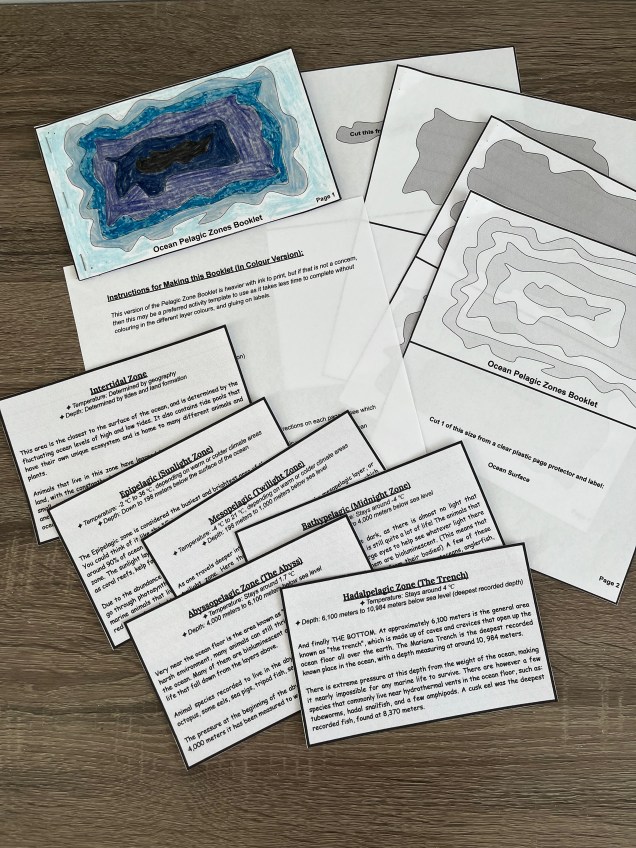
    Showing (1) completed booklet, with 5 pages of B&W booklet template, and the B&W Info cards.

    What is Included in this Digital Package? (Total 17 Pages)

    • Ocean Pelagic Zones Booklet (Colour Version) & Instructions
    • Ocean Pelagic Zones Booklet (Black and White Version) & Instructions
    • Pelagic Zone Info Cards (Colour Version)
    • Pelagic Zone Info Cards (Black and White Version)
    • Terms of Use

    **Please Note that this is a DIGITAL FILE. There is no physical product from this purchase. After purchasing, there is a link that is automatically sent to your email where you can access your new file.

    The Pelagic Zone Booklet:

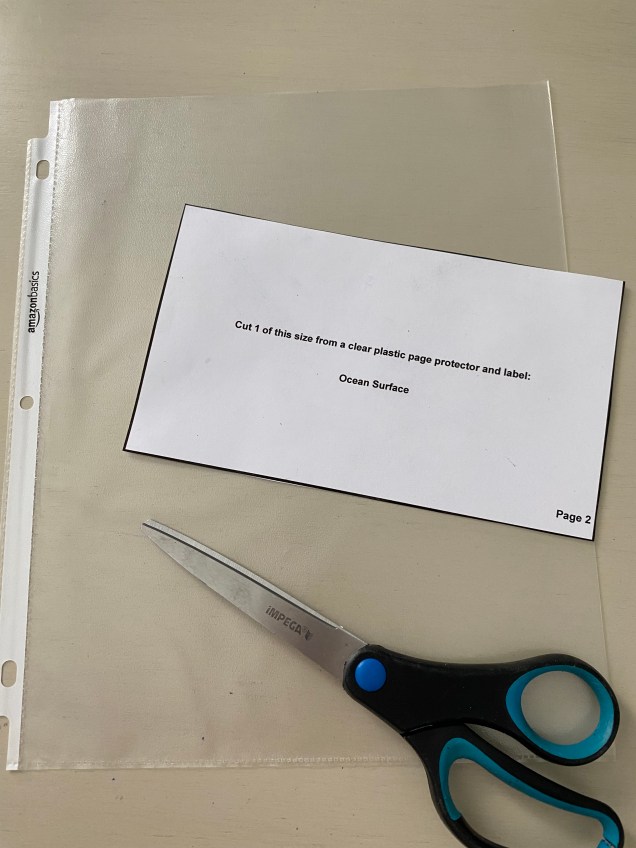
    Kids can use either one of the booklet template versions to cut and staple together their own mini pelagic zone books. Both the B&W and the Colour version were designed to insert a transparent page protector cut to represent the ocean’s surface. (This is of course optional, but my daughter and I thought it was a cool part of the activity!)

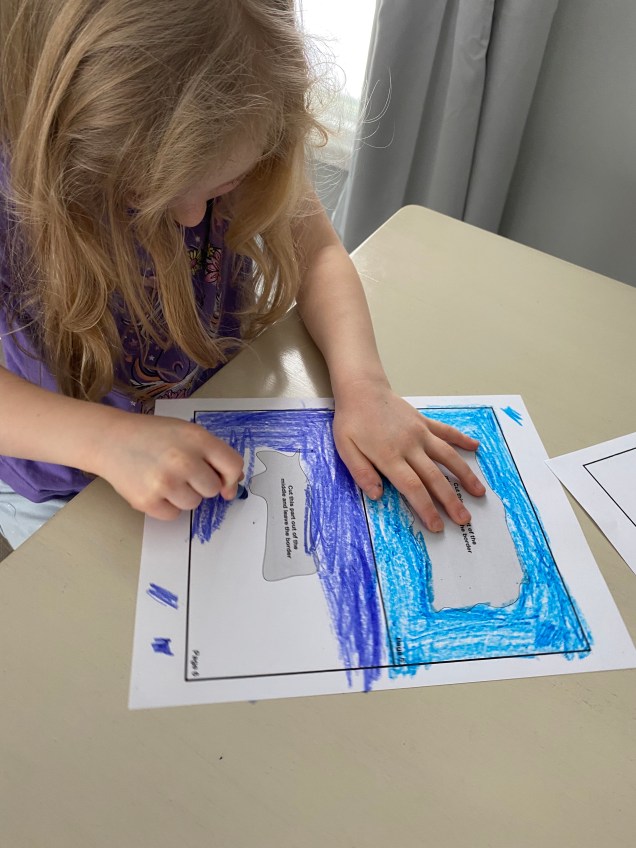
    Showing my daughter’s completed booklet cover with the B&W booklet template

    The black and white version has the extra steps of colouring or painting the different layers and then gluing on the different layer’s labels. This version is printer-friendly, and has detailed instructions on how to complete the booklet.

    The In-colour version booklet template

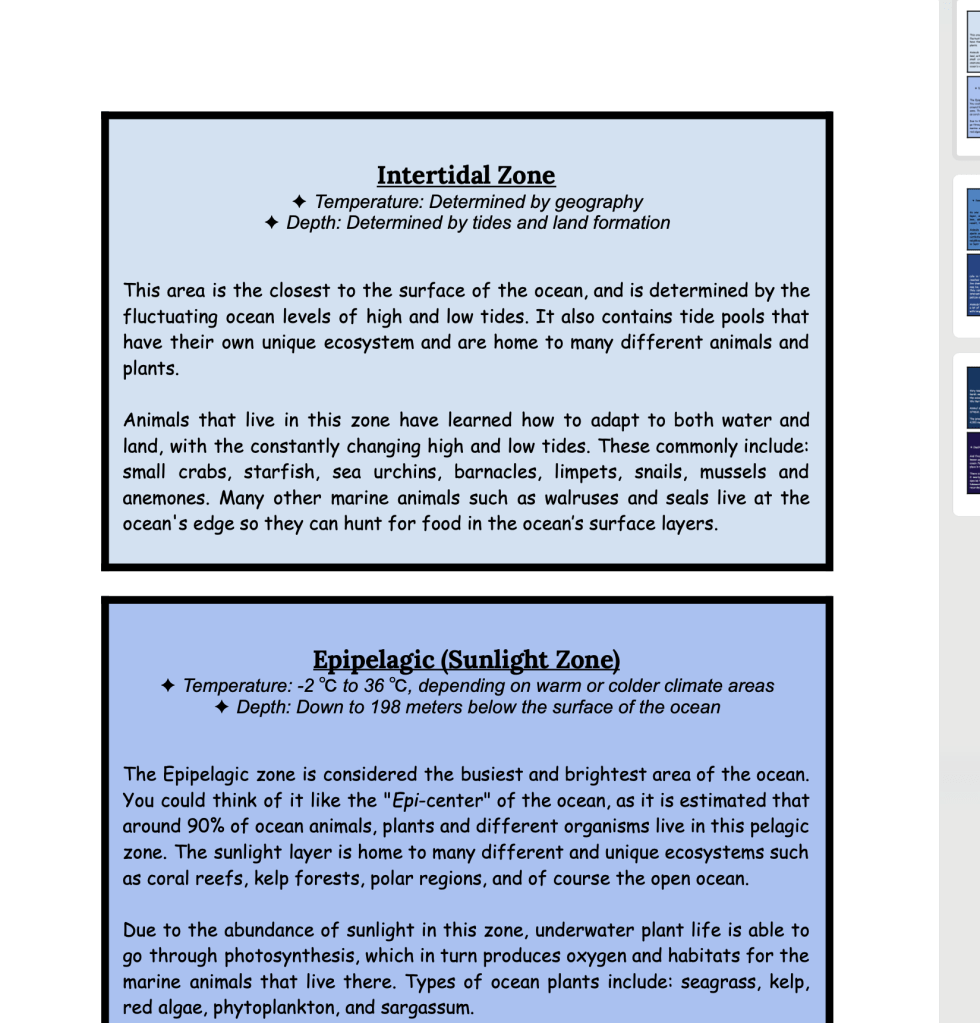
    The in-colour version may be heavier on ink usage, but the added step of colouring or painting the layers is already done, and the labels are already included, which enables this project to be completed in less time. The pelagic layer colours also coordinate with the coloured version of the pelagic zone info cards.

    The finished product size is approximately 7.5″ x 4.5″.

    Supplies Needed for this Activity:

    • Scissors
    • Gluestick (**not required for the in-colour version)
    • PDF template printed (pages 1-4, instructions are page 5) **I recommend printing on white cardstock if you are painting in the coloured layers)
    • Plastic page protector (cut in half if size is 8.5″x11″, use template for sizing)
    • 6 Different Crayon or Marker shades of blue, navy blue, purple and black. (You could also paint if you prefer!) (** Not required for the in-colour version)


    Pelagic Zone Info Cards:

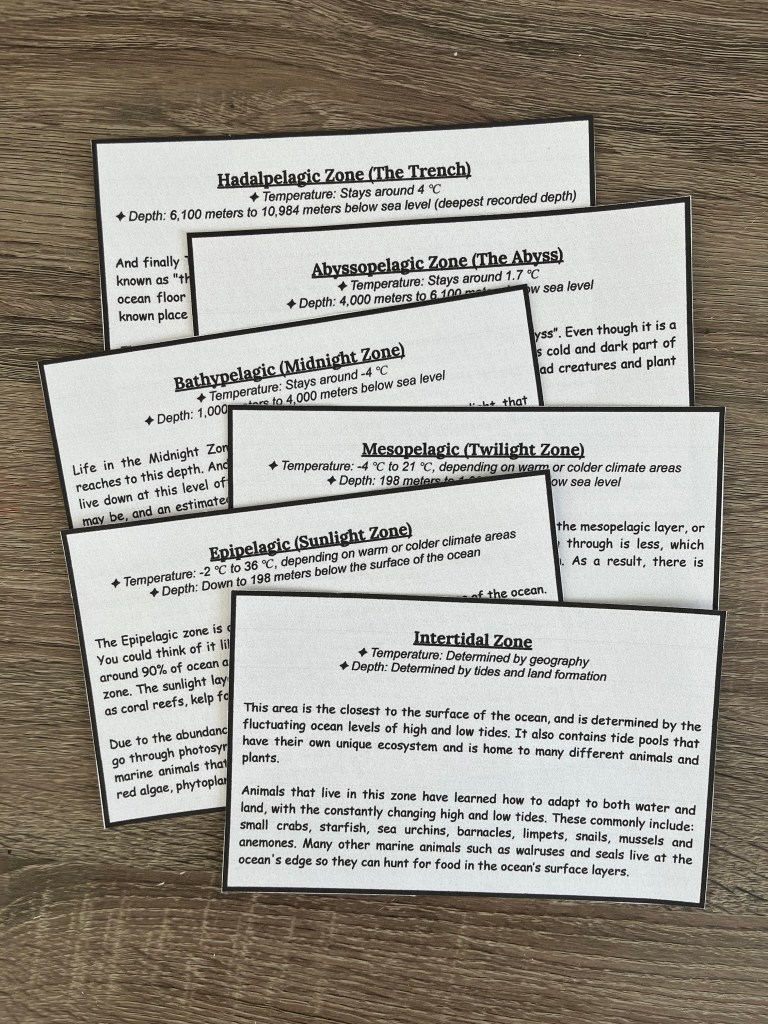
    Each of the Pelagic Zone Info Cards relates to a layer of the ocean and has details included of the following:

    • Approximate recorded depth
    • Average recorded temperature for that zone
    • Plant life or unique habitats to that zone
    • Marine animals
    • Other known facts related to that zone

    The black and white version is of course printer friendly, and the in-colour version uses the same ocean layer colours as the coloured pelagic booklet template! So if using lots of coloured ink is not an issue then this is a great option!

    Thank you for your interest in this product!

    ** This is a DIGITAL FILE. There is no physical product from this purchase. After purchasing, there is a link that is automatically sent to your email where you can access your new file.

    Hi, I’m Jessie!

    I’m a Wife and Homeschooling Mom living in a remote town in Northern Ontario, Canada. I love making wholesome meals for my family from scratch, homeschooling our girls and learning more about natural living.

    Read more about my story HERE.

    Subscribe to Northbird’s email list to get weekly posts on: tasty recipes, activity ideas for kids, natural living tips, and some genuine mom thoughts and encouragement!

    Return to Top

    This post may contain affiliate links. As an Amazon associate, I earn from qualifying purchases. This means that I make a small commission at no extra cost to you. You can read my full disclosure HERE.
    Fun Salt Water Painting Activity for Kids

    Find Northbird on social media:

    This post contains affiliate links. As an Amazon associate, I earn from qualifying purchases. This means that I make a small commission at no extra cost to you. You can read my full disclosure HERE.
    Return to “Homeschooling Activities & Resources”

    Return to “Ocean Life”

    Jump to Printable Activity Card

    Investigating Salt Water in Homeschooling:

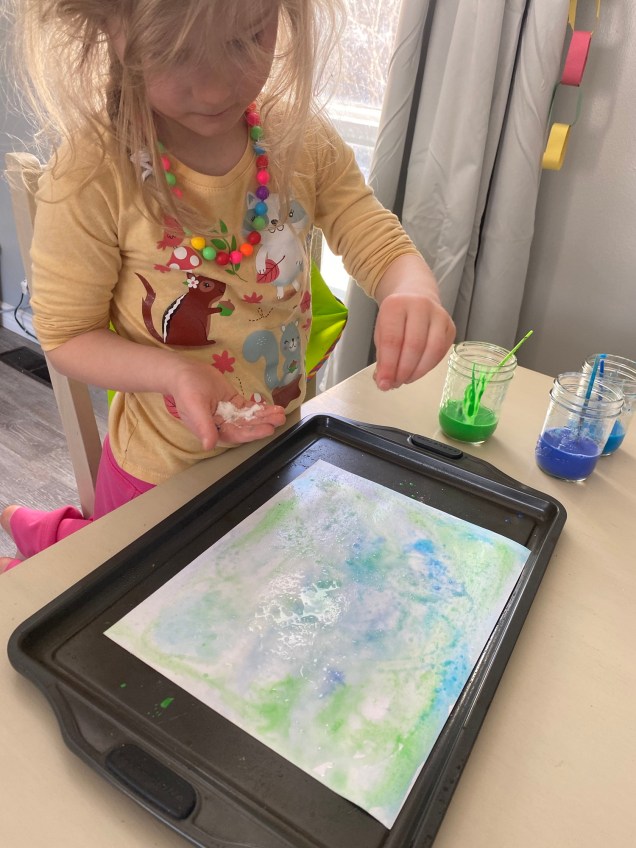
    This is a simple and fun painting craft using salt and watercolours!

    We did this easy activity as part of our inquiry into Ocean Life last year, learning about the difference between salt and fresh large bodies of water.

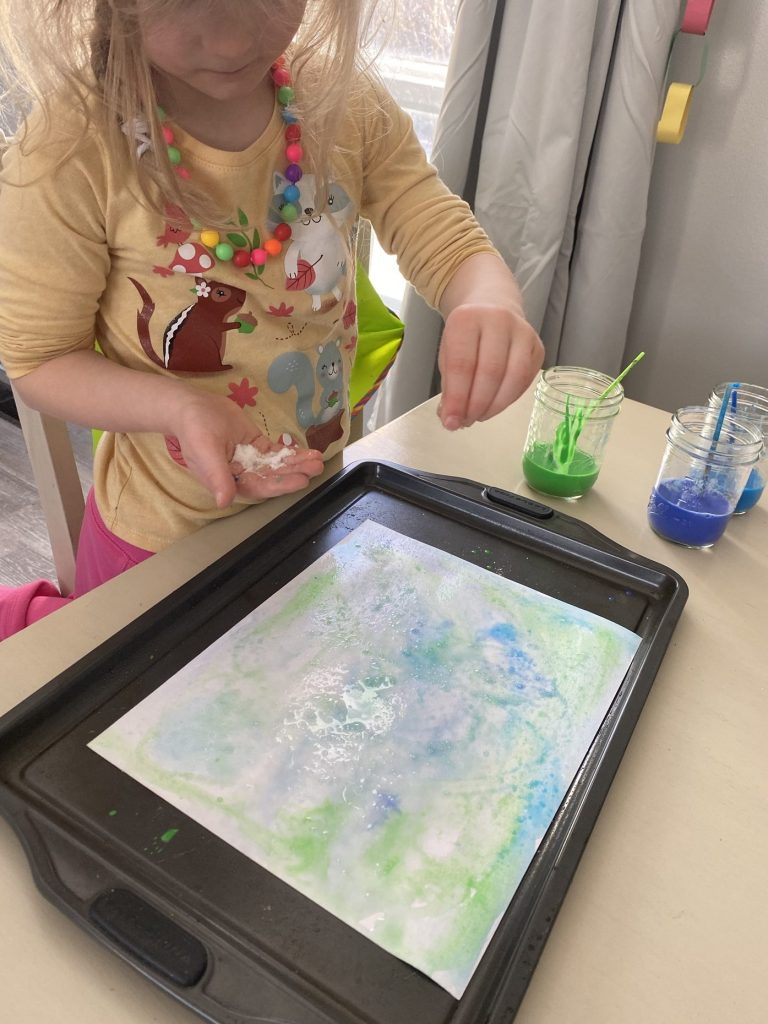
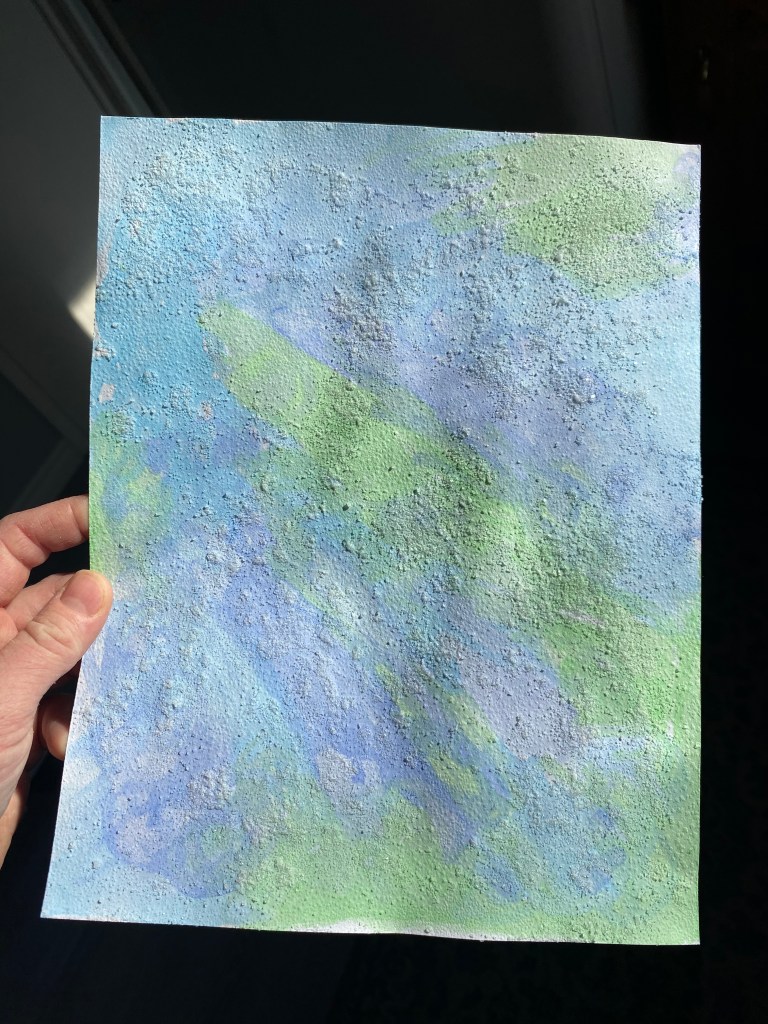
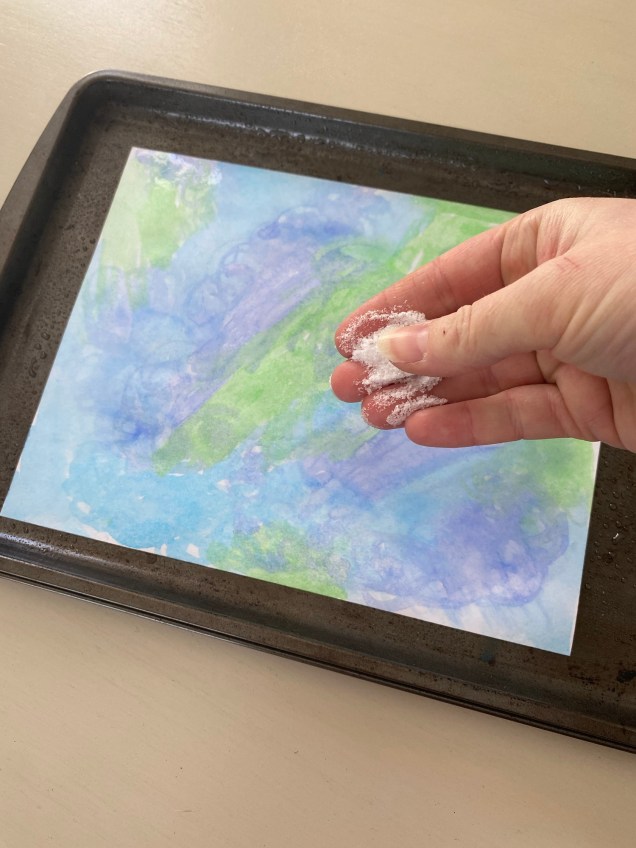
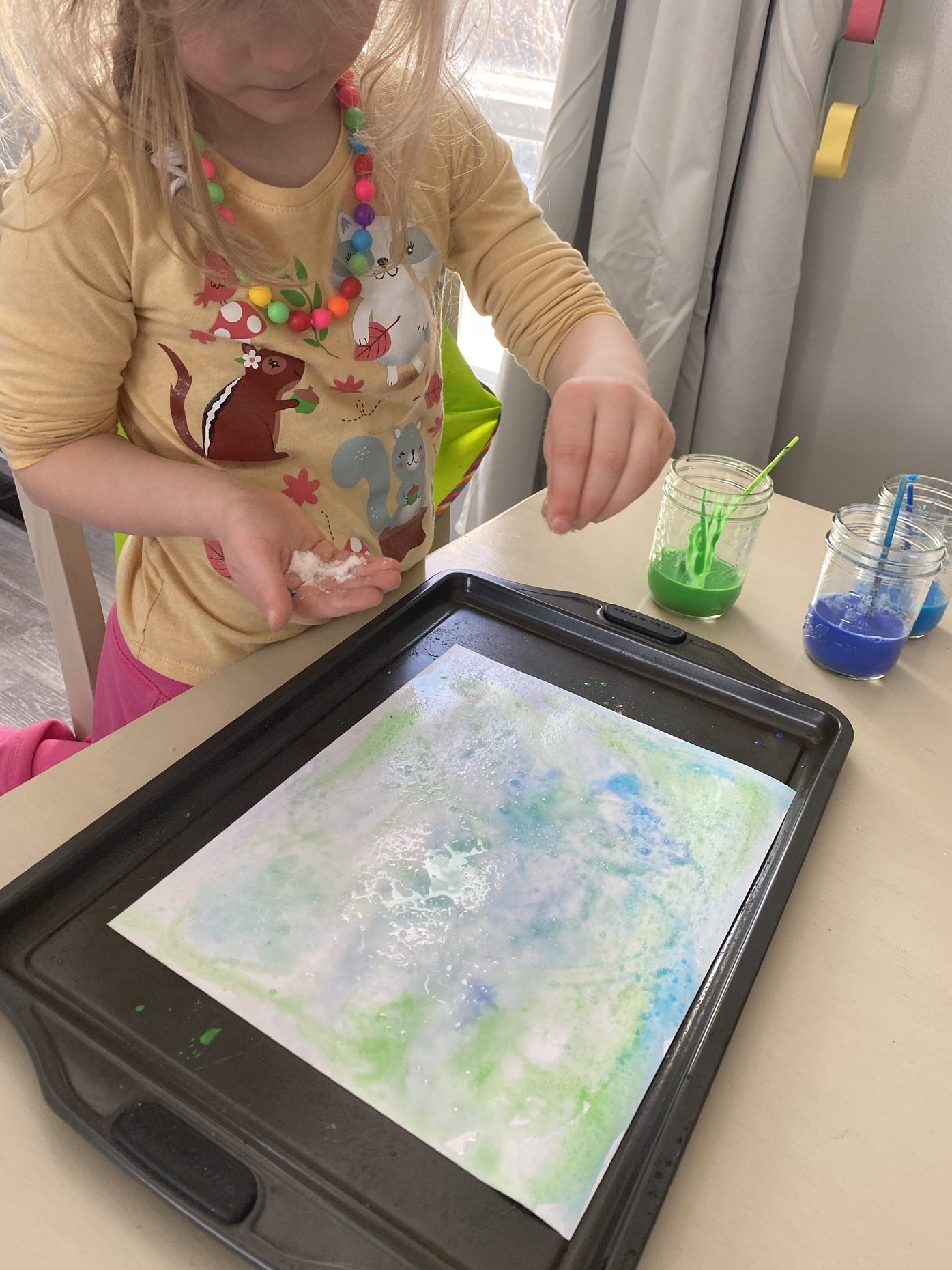
    My kids loved doing this freestyle watery painting and then getting to sprinkle it with table salt. It left a textured feel to the painting, as well as altering the colours while the salt dried on the wet paper.

    As a side note, we live near James Bay, Northern Ontario, and the river not far from our house is mostly fresh water. However, because it flows into James Bay (which is connected to the Arctic Ocean) and has some tidal changes, it carries back some salinity to our community area.

    If you read a previous post on “Exploring Salt Water Density: Homeschooling Egg Experiment”, you might already see or understand a little of the relationship between salt and water. This egg experiment was to test the different levels of density in each of these water glasses, and compare it to the egg’s own density.

    (Spoiler alert, the kids made an egg float in salted water!)

    Educational Videos: A little more about Salt and Saltwater!

    Where Does Salt Come From?

    Why The Ocean Needs Salt:

    How to Make a Salt Water Painting:

    Supplies Needed:

    Directions:

    1. Put white card stock paper on tray.

    2. Paint picture as desired with ocean colours (or more!)

    3. Sprinkle table salt over the painting.

    4. Spray paper with water to help the salt dissolve a little and alter the colours.

    5. Let painting completely dry, then gently brush off the extra salt and enjoy the results!

    Made this Activity?

    I’d LOVE to see your results!! Feel free to post to your social media account and tag Northbird using one of the links below or post in the comments!

    Hi, I’m Jessie!

    I’m a Wife and Homeschooling Mom living in a remote town in Northern Ontario, Canada. I love making wholesome meals for my family from scratch, homeschooling our girls and learning more about natural living.

    Read more about my story HERE.

    Subscribe to Northbird’s email list to get weekly posts on: tasty recipes, activity ideas for kids, natural living tips, and some genuine mom thoughts and encouragement!

    Salt Water Painting Activity

    This is a fun way to paint using salt and watered down paints! Our kids loved the texture the salt left on the paper, as well as the way the salt affected the way their pictures turned out!


    Jessica Burman, 2025 © The Northbird Blog. https://www.thenorthbirdblog.com

    Ingredients

  • Watercolours Paints (you can also use food colouring and water, or watered down other paints)
  • Paintbrushes
  • Tray
  • White Cardstock Paper
  • Table Salt
  • Spray Bottle with water
  • Flat surface to let pictures dry

  • Directions

    1. Put white card stock paper on tray.
    2. Paint picture as desired with ocean colours (or more!)
    3. Sprinkle table salt over the painting.
    4. Spray paper with water to help the salt dissolve a little and alter the colours.
    5. Let painting completely dry, then gently brush off the extra salt and enjoy the results!

    Return to Top

    Exploring Salt Water Density: Homeschooling Egg Experiment

    Find Northbird on social media:

    This post contains affiliate links. As an Amazon associate, I earn from qualifying purchases. This means that I make a small commission at no extra cost to you. You can read my full disclosure HERE.

    Jump to Printable Activity Card

    Jump to Video

    Return to “Homeschooling Activities & Resources”

    Return to “Ocean Life”

    What is density?

    Why do some things float in water and others sink? It all comes down to density.

    Density is the measurement of how compact an item is. If an item generally feels heavy, then it has high density, and if an item feels light then it has low density.

    For example, a rock has high density and will sink when you throw it in the water. But if you throw a dry stick in the water, it will float because the particles that make it up are more spread apart, and it is less dense than the water.

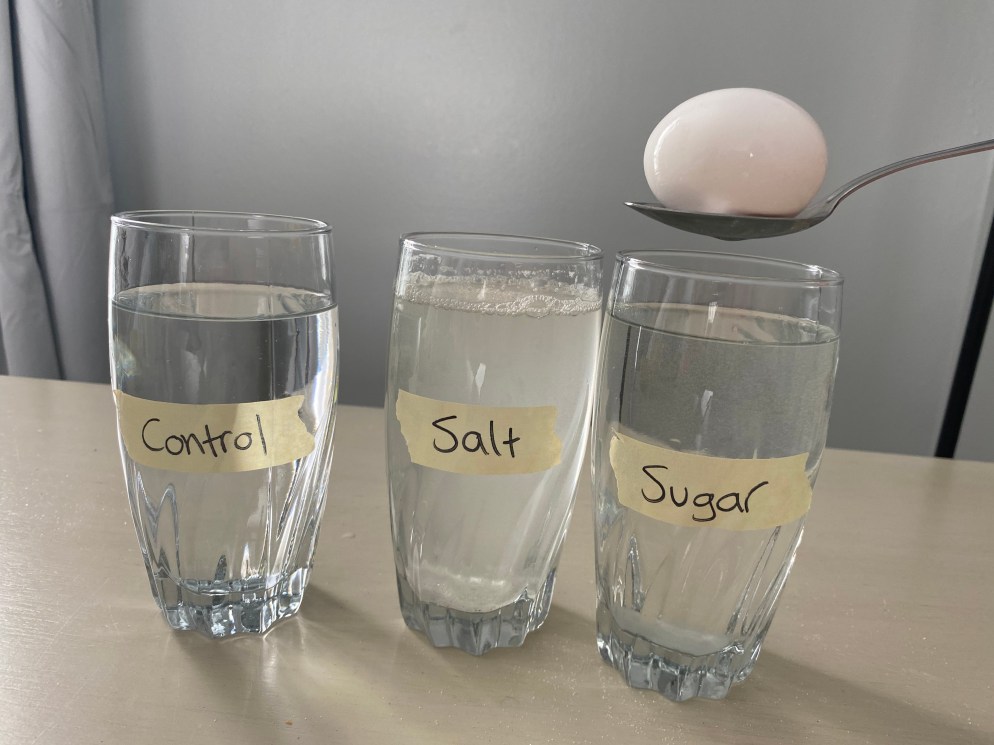
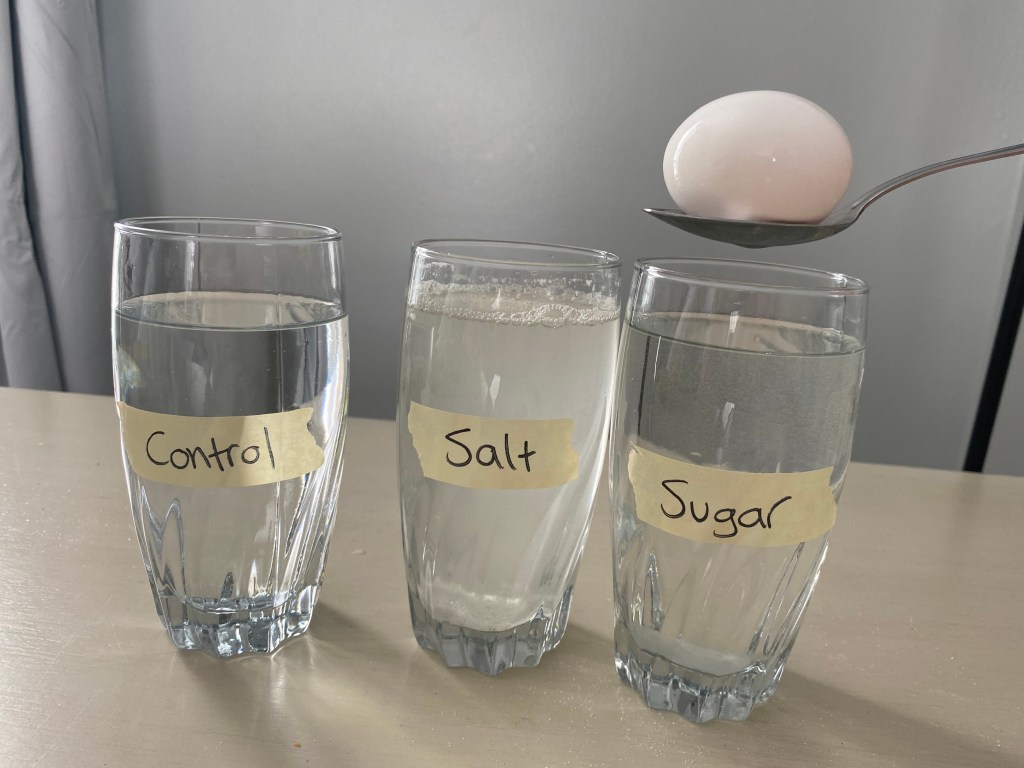
    We did a little experiment at home to test the buoyancy of an egg when first submerged in water, then sugar water, then lastly in salted water. This was to test the different levels of density in each of these water glasses, and compare it to the egg’s own density.

    This was my oldest’s first time learning about density and salinity. She was quite baffled that we were actually able to make the egg float!

    (My toddler’s favourite part was watching the glasses be stirred and the sugar and salt getting dissolved!)

    Check out the directions below to do this yourself at home!

    Here’s a short video of the process and the kid’s delight in seeing the egg bobbing in the glass!

    Egg Density Experiment:

    Supplies Needed:

    Directions:

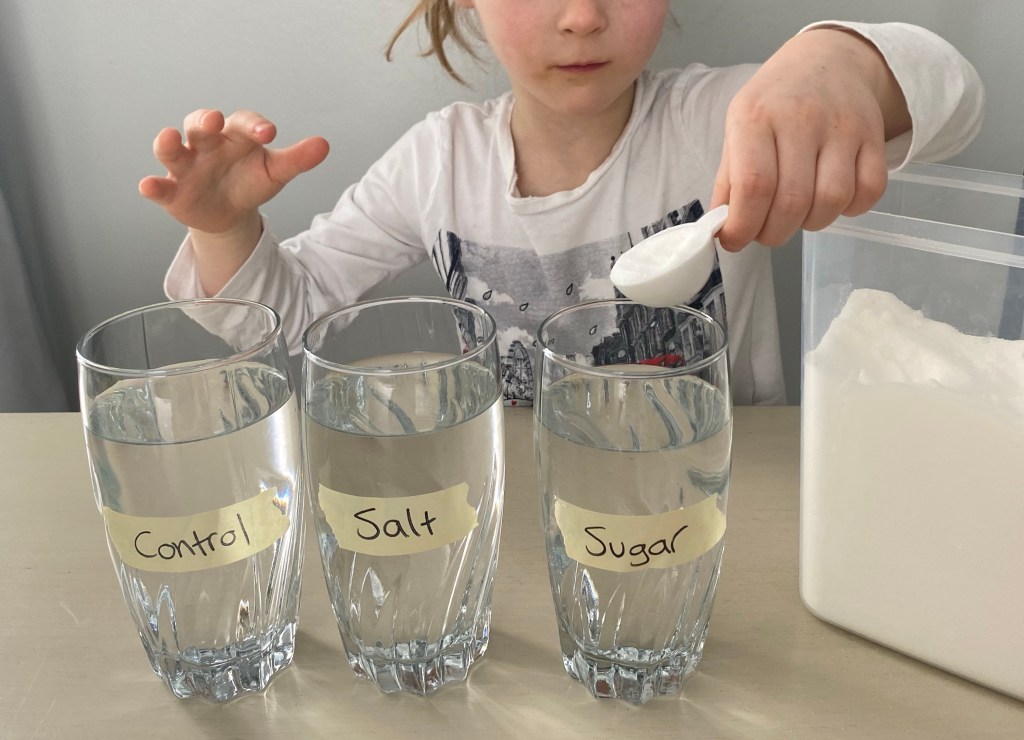
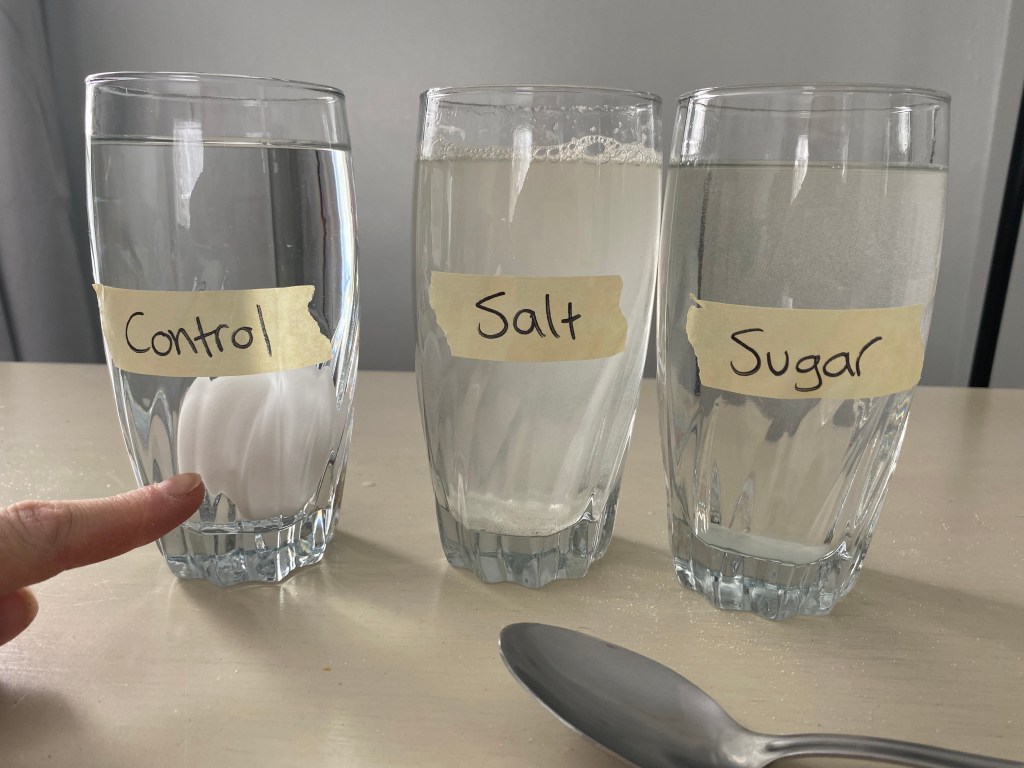
    1. Fill the 3 glasses with equal amounts of cold water.
    2. Label each glass: 1-Control, 2-Salt, 3-Sugar.

    3. Put 8 Tablespoons of table salt in the “Salt” glass and stir well until dissolved.

    4. Put 8 Tablespoons of granulated sugar in the “Sugar” glass and stir well until dissolved.

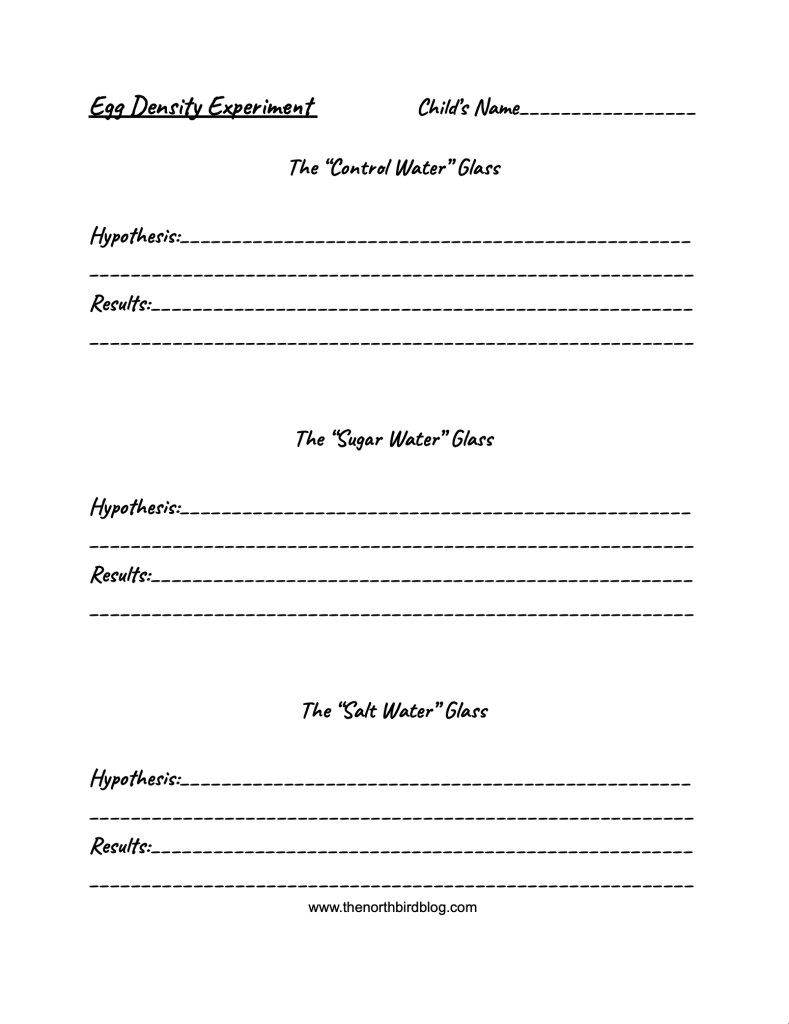
    5. Ask the kids what they think will happen. They can write their “hypothesis” in the attached PDF printable at this point.

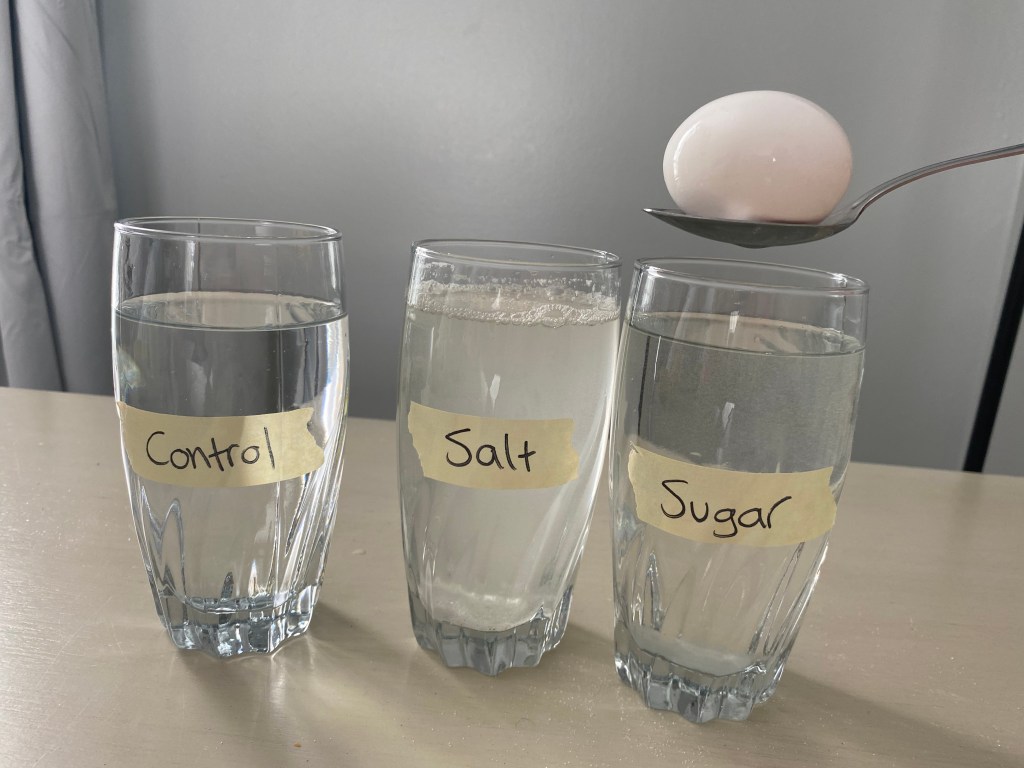
    6. Place egg carefully in the “Control” glass (you might want to use the spoon to lower it in…!)

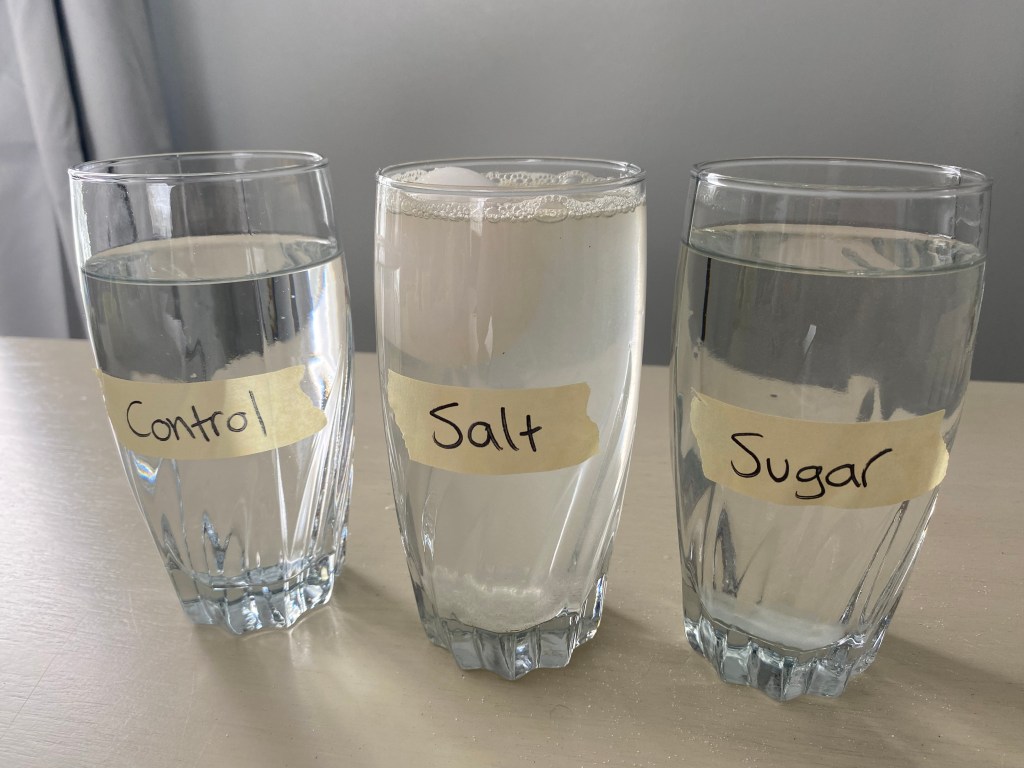
    7. Then put egg in the “Sugar” glass, followed by the “Salt” glass, and see the results! If easier, use two eggs for these glasses to compare the egg’s buoyancy.

    8. Document your findings and compare your results to the hypothesis made earlier. See if you guessed right or were surprised!

    Our Findings:

    We discovered that in the “Control” glass of water, the egg was more dense than the water, so it sank.

    The “Sugar” glass of water was more dense than the “Control” water, but not more dense than the egg, so the egg lifted a bit in the water but didn’t float on the surface.

    The “Salt” glass of water had the highest density. We discovered that when the egg was put in it, it floated on the water’s surface. This showed that the egg had a lower density than the salted water.

    Educational Videos

    “Why is it called “Dead Sea”? Why does everyone float in this sea?” by Science ABC

    This is a very detailed thorough video about the density of salt in the Dead Sea (Israel). They discuss why people can effortlessly float in it, and how there is such a high amount of salt in that particular body of water. This video is definitely geared toward older kids (my 6 year old’s eyes sort of “glazed over” after a few minutes in!)

    “Why is the Ocean Salty?” by Mystery Science

    This video is well done and designed to engage younger grades. It is full of questions that younger kids ask (at least ones that my oldest has asked me and I had no idea the answer to!).

    I love how there is also a part where they recommend pausing the video to discuss with the kids “Why do you think the ocean is salty but lakes and rivers aren’t?”

    Sink or Float?” by SciShow Kids

    This cute video discusses the topic of density and how the density of different items compare with the density of water. There is a simple experiment that you can do at home alongside the video so that younger kids can test this concept out for themselves. The conclusion of the study is communicated clearly, making it easy for younger kids to understand the concept of density.

    Other posts on Ocean Life:

    Hi, I’m Jessie!

    I’m a Wife and Homeschooling Mom living in a remote town in Northern Ontario, Canada. I love making wholesome meals for my family from scratch, homeschooling our girls and learning more about natural living.

    Read more about my story HERE.
    Subscribe to Northbird’s email list to get weekly posts on: tasty recipes, activity ideas for kids, natural living tips, and some genuine mom thoughts and encouragement!

    Exploring Salt Water Density: Homeschooling Egg Experiment


    Supplies Needed

  • 3 tall glasses
  • 6 Tablespoons of table salt
  • 6 Tablespoons of granulated sugar
  • An egg
  • A spoon
  • Label & marker
  • PDF printed experiment page

  • Directions

    1. Fill the 3 glasses with equal amounts of cold water.
    2. Label each glass: 1-Control, 2-Salt, 3-Sugar.
    3. Put 8 Tablespoons of table salt in the “Salt” glass and stir well until dissolved.
    4. Put 8 Tablespoons of granulated sugar in the “Sugar” glass and stir well until dissolved.
    5. Ask the kids what they think will happen. They can write their “hypothesis” in the attached PDF printable at this point.
    6. Place egg carefully in the “Control” glass (you might want to use the spoon to lower it in…!)
    7. Then put egg in the “Sugar” glass, followed by the “Salt” glass, and see the results! If easier, use two eggs for these glasses to compare the egg’s buoyancy.
    8. Document your findings and compare your results to the hypothesis made earlier. See if you guessed right or were surprised!

    Return to Top